Ninth Circuit Independent Contractor Misclassification Rulings
California's ABC test is now settled law, and delivery operations face the steepest exposure.

What the ABC test requires, and where delivery operations are most exposed
The Ninth Circuit ruled on May 16, 2025, that California's ABC test survives yet another constitutional challenge, this time from a trade group representing independent truckers that argued the standard violates the Commerce Clause and Equal Protection. The challenge failed. That makes it at least the second time this appellate court has looked at AB5 and told challengers, politely but firmly, to pound sand. For any company moving freight or running a contractor fleet through California, Oregon, Washington, or the other six states under the Ninth Circuit's jurisdiction, that's the fact pattern governing the ground they stand on now: the ABC test is settled law, not a passing political fad, and a business model built on the assumption otherwise is a bet against a court that has already shown its hand twice.
AB5, passed in 2019, made worker classification in California default to "employee" unless a company checks three boxes at once. Missing one collapses the whole thing. That's the structural quirk that trips up so many operators: it's pass-fail on all three prongs simultaneously, no partial credit, no weighted average where two strong prongs cover for a weak one.
Prong B is where delivery and courier companies get stuck. It asks whether the worker performs work outside the usual course of the hiring company's business, and for a delivery company whose contractors deliver things, that's a hard case to make with a straight face. A software company hiring a contractor to move boxes out of a warehouse might clear that bar. A delivery company whose entire revenue model runs on people delivering things cannot claim its delivery drivers are incidental to the business. They are the business.
Prong C asks for proof of a genuinely independent trade: courts want evidence the worker holds themselves out to the broader market, through their own business registration, other clients, their own tools, their own risk. And the law reaches past state lines. An out-of-state trucking company sending drivers into California for pickups and drop-offs is still bound by California's test on that California work, wherever the company itself is domiciled.
The three simultaneous federal standards operators must navigate alongside California's
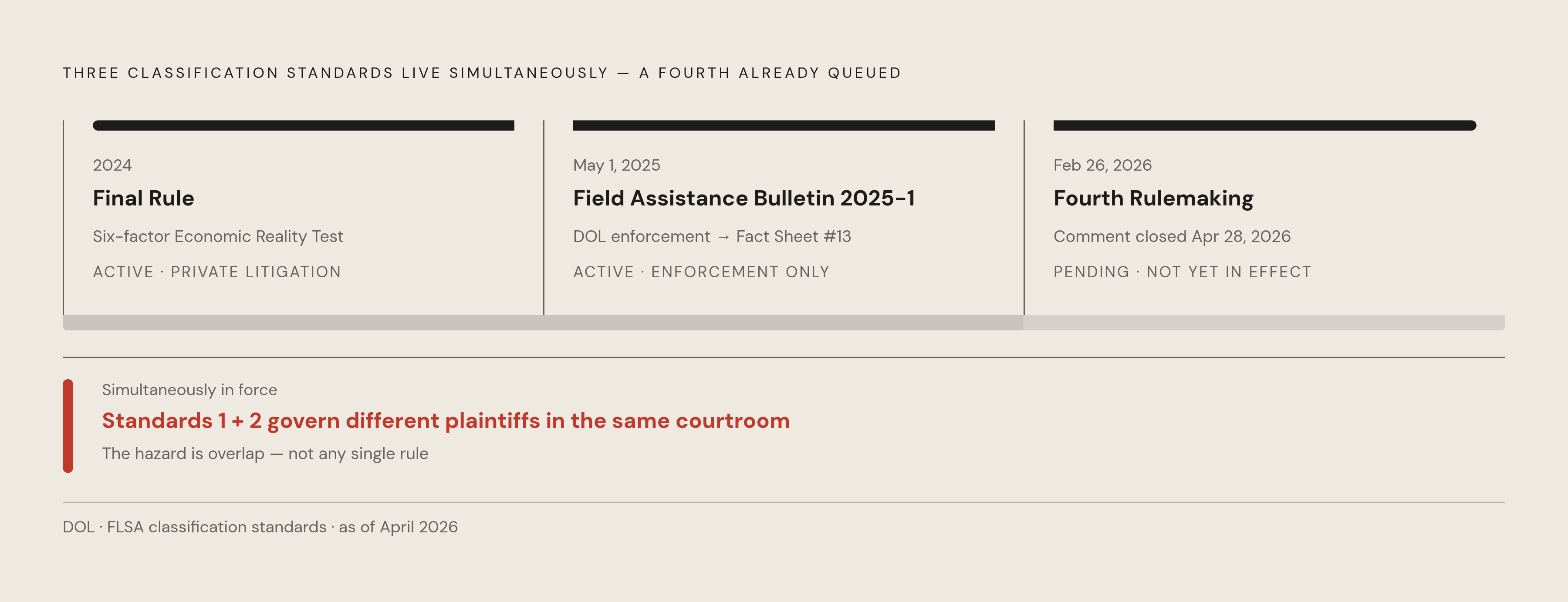
California isn't the only regulator with an opinion, and the federal picture right now looks less like a single standard than three of them stacked on top of each other, all live at once.
A federal labor agency's 2024 Final Rule restored the six-factor Economic Reality Test under federal wage law. No single factor decides a case on its own, but economic dependence on the hiring company leans hard toward employee status. Then, on May 1, 2025, that same agency issued Field Assistance Bulletin 2025-1, telling its enforcement division not to apply the 2024 rule in current enforcement. Enforcement reverted instead to the older Fact Sheet #13 and a reinstated 2019 opinion letter, FLSA 2019-6, friendlier to the contractor model.
That sounds like relief. It isn't, not fully. The bulletin itself says the 2024 rule "remains in effect for purposes of private litigation and nothing in this FAB changes the rights of employees or responsibilities of employers under the FLSA." Government enforcers may have stood down, but a driver's lawyer hasn't, and private lawsuits can still run on the 2024 standard even while the DOL looks the other way. Then, on February 26, 2026, the DOL announced yet another rulemaking, a fourth version of the federal standard now in the works, with the comment period closing April 28, 2026. Three standards running at once, with a fourth already queued up. Operators are driving three lanes at the same time and hoping none of them merge into a wall.
What misclassification costs when enforcement catches up
Misclassification isn't a rare slip that happens to unlucky companies. Estimates put the share of employers misclassifying at least some workers somewhere between 10 and 30 percent. For a meaningful chunk of the industry, that's an exposure already live, quietly accruing while everyone waits for an audit or an ex-contractor with a lawyer.
The dollar figures scale badly for anyone running a real contractor network. California caps penalties at $25,000 per violation, and since that's per violation and not per company, it adds up fast at any real fleet size. New Jersey runs a different formula: up to 5 percent of gross earnings, plus a flat $250. And that's before the IRS shows up. Federal back-tax exposure on a misclassified worker can run to 41.5 percent of that worker's earnings, stacked on top of whatever state penalties already applied. None of this is a theoretical ceiling reserved for the worst offenders. It's the baseline math for anyone caught with a contractor roster that doesn't hold up.
The classification terrain for trucking operators versus app-based delivery platforms
Not every gig-economy company holds the same hand. App-based platforms like Uber, Lyft, and DoorDash operate in California under Proposition 22, a ballot-measure carve-out letting them classify drivers as contractors provided they offer minimum earnings guarantees and a few other protections. That's a negotiated political settlement voters approved at the ballot box. It is not a court ruling that the underlying business model satisfies the ABC test. One is a deal. Confusing a negotiated political settlement voters approved at the ballot box with a court ruling that the underlying business model satisfies the ABC test is the mistake to avoid here.
Prop 22's minimum earnings floor and its emphasis on letting drivers choose which jobs to accept line up reasonably well with where the 2026 DOL framework is heading, which also leans on worker choice as a marker of independence. But even under Prop 22, a driver working almost exclusively for one platform, logging the hours and pattern of a full-time job, still risks tripping into employee status on economic dependence grounds. The carve-out helps. It doesn't make the underlying tension disappear.
Trucking carriers get no such carve-out. None. A motor carrier operating in California that classifies owner-operators as contractors gets evaluated under the full three-prong ABC test, same as anyone else, and Prong B is brutal for this model specifically: a driver hauling freight for a carrier whose business is hauling freight is about as squarely "in the usual course of business" as a fact pattern gets. The leased owner-operator structure that dominated trucking before AB5 became law is what OOIDA's 2025 challenge tried to preserve. The Ninth Circuit said no. That leaves carriers with a narrower path to lawful contractor classification than app-based platforms enjoy, carve-out or no carve-out. Trucking, in other words, drew the short straw twice: no ballot-measure escape hatch, and a Prong B fact pattern that was never going to clear the bar.
What "proactive compliance" requires structurally
Courts and regulators keep returning to the same principle: the actual working relationship controls, not the paperwork describing it. A contractor agreement that says "independent contractor" in eighteen-point bold type provides zero protection if the day-to-day reality looks like employment. Judges read the contract, then look past it, the way anyone reads a résumé and then just watches how the person actually works.
The bar for finding employee status sits lower than most operators assume, too. Control behaviors, dictating specific hours a driver must work or requiring a delivery route be run one particular way, weigh heavily against contractor status and can tip the balance even when other factors seem favorable. That's closer to a tripwire than a high threshold, and most operators are still treating it like the latter.
Real compliance means building a formal classification review into the process before a contractor ever starts work, not after a dispute lands on someone's desk. Watch for the "perma-freelancer" pattern: the same statement of work renewed year after year, full-time hours, an open-ended engagement with no natural end date. That pattern reads to a court exactly like an employment relationship wearing a contractor's badge, because that's what it is. Annual reclassification reviews are the mechanism that catches a contractor who's quietly drifted into employee territory before a lawsuit does the catching instead.
The infrastructure IC operators need to turn compliance from a recurring crisis into a sustainable operating condition
None of this scales on spreadsheets and manual file review. A contractor network big enough to matter, running across states with different rules and a moving federal target, can't rely on a compliance manager doing periodic paper checks. The math doesn't work: by the time a quarterly review flags a problem, the exposure has already accrued for three months.
What's needed instead runs continuously, not in sweeps. Onboarding has to document real independence the moment a contractor starts, not reconstruct it retroactively once a regulator asks. Credential and insurance verification needs to run as an ongoing check. Contractors doing similar work need consistent treatment across the board: inconsistent treatment is what disqualifies a company from IRS Section 530 relief, a safe harbor that requires operators to show consistent treatment across their contractor workforce. And the tracking has to run all three federal and state standards at once, because a contractor might clear California's ABC test on paper while still carrying exposure under the FLSA's economic realities test in private litigation.
Compliant infrastructure means giving contractors something, not just demanding things of them. Occupational accident insurance, built specifically for 1099 workers in trucking, courier, and last-mile delivery, can cost meaningfully less than standard workers' compensation while still covering on-the-job injury. That cuts two ways at once: it protects the contractor financially, and it demonstrates genuine independence rather than dependence on one company for coverage. Fast pay arrangements pull the same direction, giving contractors the cash-flow flexibility of an independent business rather than the posture of an employee waiting on a biweekly check. Bulk insurance purchasing, buying coverage at the fleet level instead of negotiating policy by policy, is the straightforward lever for bringing per-contractor costs down at any real scale.
None of this erases the underlying legal exposure. Only reclassifying an entire workforce as employees erases the underlying legal exposure, and doing so defeats the purpose for most of these businesses. But this kind of infrastructure turns compliance from an annual scramble triggered by a subpoena into an operating condition the business runs on every single day. Given a Ninth Circuit that has now ruled more than once, and a federal standard already on its fourth version before the ink dries on the third, that is table stakes now. It's table stakes.
Sources
- Final Rule: Employee or Independent Contractor Classification Under the Fair Labor Standards Act, RIN 1235-AA43
- US Department of Labor issues guidance on independent contractor misclassification enforcement | U.S. Department of Labor
- DOL Issues Guidance on Independent Contractor Misclassification Enforcement
- fbm.com
- hedrickgardner.com
- Ninth Circuit Rejects Challenge To A.B. 5, And Holds That Disparate Treatment Of Gig Workers Is Justified By California’s Interest In Curbing Independent Contractor Misclassification
- US Department of Labor proposes rule clarifying employee, independent contractor status under federal wage and hour laws | U.S. Department of Labor
- landline.media