California AB5 Enforcement Against Delivery Networks
California's Labor Commissioner just put a number on what a misclassified driver costs a supply chain: $868,128. California's Labor Commissioner just put a number on what a misclassified driver costs a supply chain: $868,128, in the October 2025 citation against Mega Nice Trucking, Ryder Last Mile, and Costco, what is likely the first AB5 enforcement action against a trucking and last-mile delivery arrangement, landing after five years of companies treating the law as a threat that never quite materialized. That changed with the October 2025 citation, which lands after five years of companies treating the law as a threat that never quite materialized. For any delivery operator still running independent contractor drivers on the assumption California won't come knocking, the knock has happened, and it landed on a carrier, a last-mile operator, and a retailer all at once.
What the Mega Nice / Ryder Last Mile / Costco case shows about how liability attaches
AB5 passed in 2019 and took effect January 1, 2020, but a court injunction kept it from touching trucking until mid-2022. Even after the injunction lifted, enforcement stayed quiet. By all available accounts, no comparable trucking enforcement action surfaced in the years between the injunction lifting and this citation. Then, in the space of one citation, the state answered the question everyone in the industry had been asking out loud at conferences and quietly behind closed doors about whether enforcement would ever actually arrive.
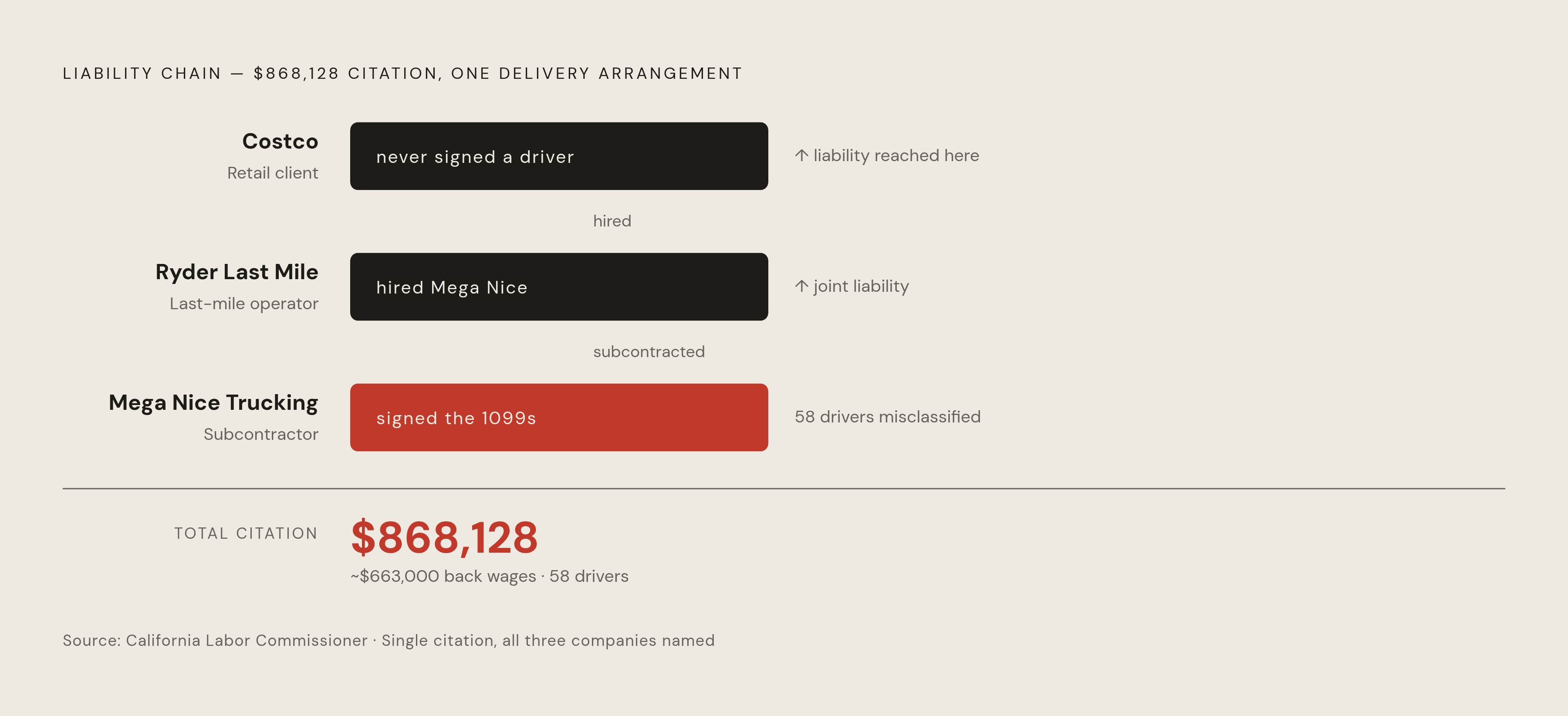
The structure of the arrangement is what matters: Mega Nice Trucking was a subcontractor working under Ryder Last Mile, which runs inside Ryder's Supply Chain Solutions segment. Mega Nice Trucking was a subcontractor working under Ryder Last Mile, which runs inside Ryder's Supply Chain Solutions segment. Costco was the retail client at the top, the company whose packages were actually getting delivered. The Labor Commissioner's Office cited all three. Not just the small trucking outfit that signed drivers up as 1099s, but the last-mile operator that hired the subcontractor, and the retailer that hired the last-mile operator.
The violations: 58 drivers misclassified as independent contractors, plus unpaid overtime and missed meal and rest breaks stacked on top. Total penalties came to $868,128, with roughly $663,000 going straight to the drivers as back wages. That's not a rounding error on anyone's balance sheet, but the bigger cost is what the case establishes as precedent: the liability didn't stop at the company that wrote the paychecks. It climbed the entire contracting chain.
Prong B of the ABC test: the structural barrier most delivery IC models cannot clear
California's ABC test, codified by AB5, asks three questions, and a worker only counts as an independent contractor if the hiring company can answer yes to all three. If a company misses one, the worker is an employee under California law. No averaging, no partial credit.
Prong A turns on whether the worker is free from the hiring company's control and direction, both in the contract language and in how the job actually runs day to day. Prong C asks whether the worker runs an independently established business in the same line of work, the kind of thing a driver with an LLC, other clients, and a real book of business might satisfy. Prong B is where almost every delivery IC model dies: it asks whether the work performed falls outside the hiring company's usual course of business.
A trucking company subcontracts a driver to move freight. Moving freight is the trucking company's business. A last-mile operator hires a contractor to deliver packages to a doorstep. Delivering packages to doorsteps is the last-mile operator's business. Prong B means a delivery driver is always doing delivery-company work; there is no argument otherwise. It's the one prong that's structurally baked into the business model itself, not something fixable with better contract language or a cleverer onboarding form.
Who is exposed (the liability chain extends well beyond the carrier that signed the contracts)
The Mega Nice precedent makes clear that joint employer liability reaches carriers, last-mile operators, and the retailers who hire them for last-mile delivery, not just whoever technically issued the 1099. Operational control triggers that liability, not the paperwork. It's operational control: who sets dispatch times, who mandates a uniform or a branded vest, who tracks on-time percentages and reroutes drivers who fall behind. Directing any of that is enough to pull a company into the liability chain, regardless of whose name is on the contractor agreement.
That reach extends past California's borders, too. Out-of-state fleets operating California routes face the same reclassification pressures as carriers based in the state. And the case reshapes due diligence for shippers and third-party logistics providers generally: it's no longer enough to check that your own hiring practices are clean. Every logistics partner in the chain, every subcontracted carrier and last-mile operator touching a California warehouse or a California delivery route, is now a liability the contracting company inherits if that partner gets it wrong.
The financial cost of getting this wrong (penalties, back wages, and the reclassification arithmetic)
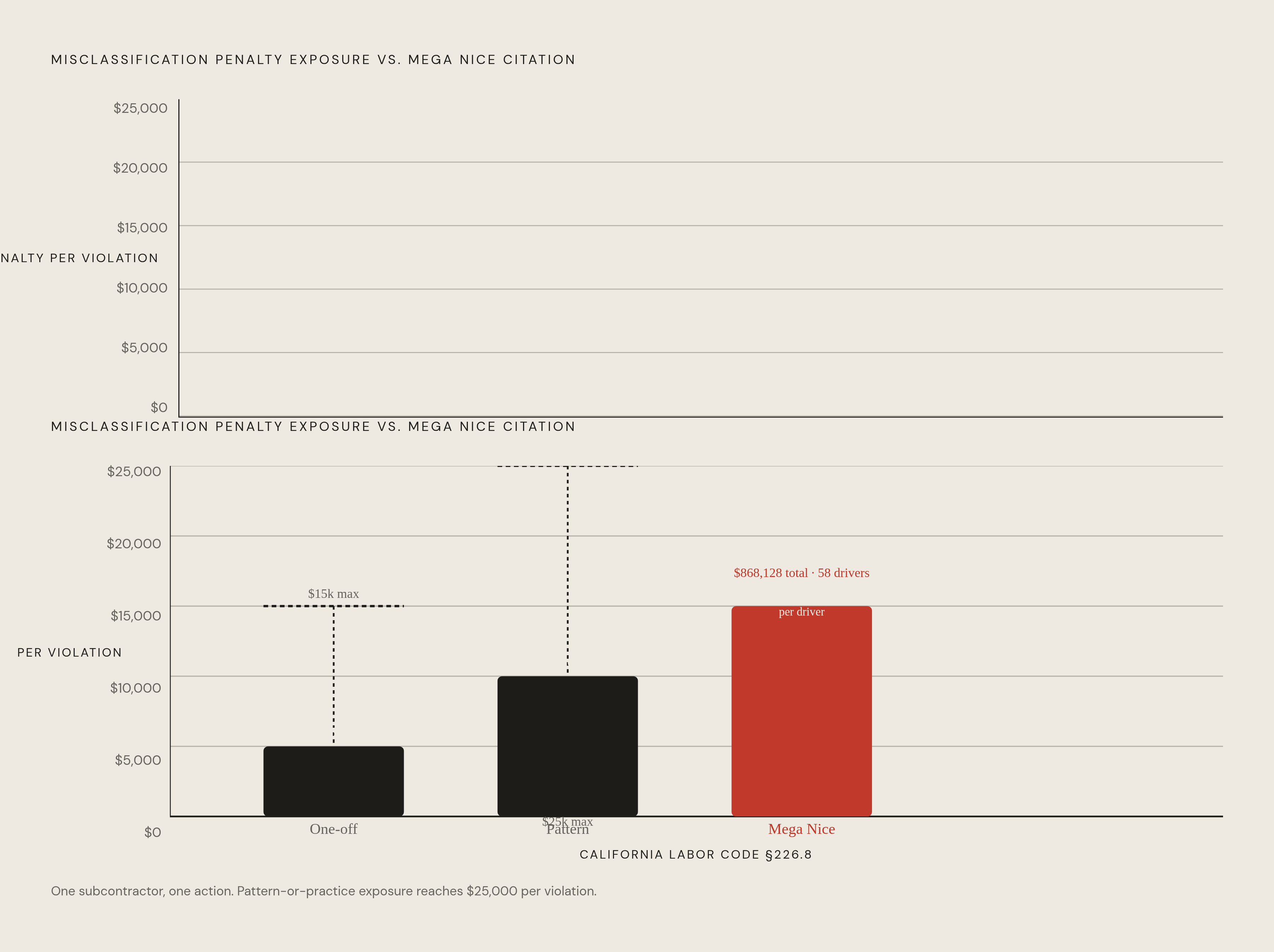
Start with the statutory range before looking at what one case actually produced. California Labor Code Section 226.8 sets civil penalties at $5,000 to $15,000 per violation, and $10,000 to $25,000 per violation if the state finds a pattern or practice of misclassification rather than a one-off mistake. On the federal side, misclassified workers can trigger IRS back-tax exposure running to roughly 41.5% of their earnings, with California layering on state fines up to $25,000 on top.
Setting the Mega Nice numbers against that range makes the case look almost restrained. The $868,128 figure was a real but contained hit spread across 58 drivers, and this was a single enforcement action, not a pattern-or-practice finding. A pattern-or-practice determination against a larger network, one running hundreds of drivers across multiple contracts instead of 58 on one, would scale those penalties multiplicatively rather than linearly. The Mega Nice figure is a floor. It's the number you get when the state catches one subcontractor once. Nobody in this industry should be using it as their worst-case scenario.
The one narrow exemption that works (what Prop 22 compliance requires for app-based delivery)
There is exactly one legally durable carve-out for IC classification in California's gig economy, and it's Prop 22. The California Supreme Court upheld it in July 2024, so the exemption sits on solid legal ground for now. But it applies narrowly: Prop 22 covers app-based rideshare and delivery platforms specifically. It is not a general license for trucking companies or last-mile subcontractors to keep running drivers as 1099s.
Compliance under Prop 22 comes with real, specific obligations. Companies need a written independent contractor agreement, a requirement Prop 22 imposes directly and one that SB 988 separately requires for qualifying freelance contracts. Drivers have to be paid at least 120% of minimum wage for engaged time, plus $0.37 per mile, plus a healthcare stipend. Companies must issue quarterly earnings statements, and drivers need occupational accident insurance backed by a policy with a substantial coverage limit.
DoorDash's PAGA claim got dismissed in January 2025 because the company produced quarterly statements showing driver earnings at 122% of minimum wage, the $0.37 per-mile rate, and the healthcare stipend, all as contemporaneous records. Courts are now accepting screenshots pulled straight from the driver-facing app as valid documentation. That's the compliance bar. Not a policy on paper, but a receipt trail a court can read.
Restructuring delivery workforce models to operate compliantly in California
Carriers operating in California are converging on a handful of models that can actually survive an audit. The first is full conversion to a W-2 employee-driver workforce, which gives the greatest legal certainty but demands real capital: fleet investment, payroll infrastructure, benefits administration, the whole apparatus of being an employer instead of a contract-writer.
The second is working through leased fleets or motor carriers that already employ their drivers as W-2 workers, which pushes the employment relationship, and the classification risk that comes with it, onto that carrier. The third, chosen by some operators, is partial exit from the California market, a straightforward conclusion that the compliance cost now exceeds what the California route is actually worth.
Hybrid structures, cooperatives, and broker networks appear as operators try to engineer their way around Prong B by redefining what counts as their "usual course of business." And one model in particular is spreading fast: outsourcing drivers to third-party employment organizations that already classify them as W-2 employees, so the carrier buying the labor never touches the classification risk directly. The effect on the industry is broad. Over 100,000 trucking firms and more than 70,000 owner-operators now face reclassification pressure, and enough of them have pulled back from California to open capacity gaps in the 10% to 15% range, while reclassification and compliance costs have driven substantial cost increases across the sector.
Real-time compliance infrastructure for IC-model delivery networks operating outside California
California is the leading indicator of this problem, not its outer limit. It's the leading indicator. The enforcement pattern that emerged in 2025 and is expected to build through 2026, audits triggered by driver complaints, insurance reviews, and court proceedings, can arise under any state's version of the same mechanism. Any state with a misclassification statute on the books can run the same playbook.
The real lesson from Mega Nice is how ordinary the underlying behavior was. Setting schedules, requiring uniforms, enforcing delivery protocols, monitoring performance metrics: none of that is exotic. It's how last-mile delivery gets managed everywhere, every day. Which means the compliance gap it creates is invisible right up until an audit shows up and makes it visible, expensively.
A handful of practical habits actually close that gap before it becomes a citation. Periodic review of control behaviors matters: how dispatchers communicate with drivers, how loads get assigned, whether a given contractor is working exclusively for one company or genuinely juggling multiple clients. Contracts need review for language that quietly signals an employment relationship, alongside real documentation supporting any B2B exemption claim. Dispatchers and frontline managers need training, since misclassification often starts with someone in ops directing a driver's day without realizing that direction itself creates legal liability. And credential files, insurance verification, and onboarding records need to stay current and complete.
Periodic auditing, though, runs into a structural problem the Mega Nice case exposes directly: liability accrues continuously, not at the moment of discovery. The back wages in that case reflected the accumulated cost of misclassification over the period under review. A company checking its compliance once a quarter is still accumulating exposure every single day in between. Given that, the operators actually winning this fight are moving toward monitoring that runs continuously rather than sampling occasionally, because the ones getting caught aren't the ones with bad policies. They're the ones with good policies and a three-month blind spot.
Sources
- What Trucking Company Owners Need to Know About California's AB5 in 20
- AB5 Trucking Update: Implications for California's Trucking Industry and Supply Chains | FreightAmigo
- California AB5: Reshaping the Trucking Industry and Its Impact on Logistics | FreightAmigo
- California Labor Commissioner’s BOFE unit cites Costco, Ryder Last Mile Inc., and Mega Nice Trucking LLC for $868,128 in misclassification violations | California Department of Industrial Relations
- omnivoo.com
- californiaemploymentlaw.foxrothschild.com