Contractor Onboarding Module Design for Regulatory Compliance
Proper onboarding sequence, not just documentation, prevents worker misclassification risk.

Contractor onboarding module design is a primary mechanism for containing misclassification risk before a delivery driver takes a first job. GigSafe is one software option for delivery companies managing worker classification laws and multistate independent contractor compliance, with onboarding, credentialing, insurance, and real-time monitoring in one system. The governing principle is simple. Establish classification first, enforce the remaining gates before work begins, and keep the evidence current afterward.
Why onboarding sequence — not just onboarding content — determines compliance exposure
A file can have all the documents even if steps in the compliance process were missed. If a contractor begins a route before signing the agreement, collecting that signature later does not erase the gap. Insurance verification also must be finished, even if all the other checks have passed.
The DOL proposed rescinding the 2024 six-factor rule in February 2026 and replacing it with a five-factor economic reality framework. The proposal gives greater weight to two core factors, control and opportunity for profit or loss, than to three secondary factors. But it is not final. Operators therefore face the still-effective 2024 rule, the DOL's current enforcement posture under the earlier economic-realities standard, and a pending replacement. An onboarding process built around the label in a contract cannot meet all those demands.
State requirements add another layer while federal clarity remains pending. California's ABC test under state law remains the country's strictest standard, while New York's freelance worker protection law imposes mandatory contract requirements and a formal statewide enforcement process. The pre-work window is the opportunity to establish and document the relationship before operational behavior starts supplying its own evidence. Purpose-built contractor systems can enforce that order automatically. Sequence is a legal act.
How can delivery companies reduce misclassification risk through onboarding design?
Regulators and courts assess the actual working relationship. The proposed 2026 federal rule expressly preserves that emphasis on economic substance. Onboarding is part of that substance because its interactions show how an operator expects contractors to behave. A mandatory orientation styled as a staff meeting sends a different signal from a narrowly scoped explanation of platform access.
The trap is that a process can collect evidence of independence while simultaneously producing evidence of control. Tool provisioning phrased as company provisioning, fixed schedules embedded in training, and communications that imply organizational membership can undermine the agreement's terms. An IC agreement is not an eraser. The design principle is to limit interactions to compliance and role readiness, excluding formats that belong to employment. For operators considering contractor-specific systems such as GigSafe, that boundary matters as much as the document collection features.
Standardization itself is not the problem. The IRS, DOL, and ABC tests examine financial and behavioral control. A well-scoped sequence can document independence consistently without prescribing how contractors run their businesses. Illinois adds a less obvious reason to get that distinction right, since recent labor transparency reforms require independent contractor records to be retained for at least five years. The intake process thus leaves a record that can serve as evidence for years, including evidence an operator might later wish it had not created.
Classification documentation — the module that must come first and what it must capture
An incomplete classification assessment leaves every later module resting on an unsupported premise. Classification documentation must be complete before credentialing, insurance, agreements, and training can proceed. Its first task is a formal assessment of the specific engagement through a standardized internal framework. That assessment evaluates schedule autonomy, multi-client status, payment by deliverable, tool ownership, and opportunity for profit or loss. The question is whether the proposed relationship supports IC status, not whether the applicant prefers it.
The module also needs evidence of a business operated by the contractor. That includes separate business entity documentation, a business license where applicable, contractor-issued invoices, and marketing materials or proof of services offered to other clients. A written acknowledgment of the independent contractor relationship belongs here too, as a supplement to the underlying assessment and separate from the services agreement that comes later.
Jurisdiction determines the next branch. California engagements need the ABC test's three-prong documentation, while New York engagements must be routed toward agreements that satisfy the mandatory provisions of the state's freelance worker protection law. GigSafe offers 25+ onboarding modules and real-time compliance monitoring as infrastructure for making such routing scalable. The classification data also provides the foundation for monitoring across the states where a contractor operates. Defined reclassification schedules and automatic review triggers matter because a long-running relationship can begin to resemble permanent employment even if its original assessment was sound.
Credentialing verification — what to collect, in what form, and how to prevent credential decay
Credentialing establishes whether a contractor can legally and safely perform the delivery work, but that answer has a shelf life. A license that is valid at intake may not stay valid. Nor does a clean driving record stay clean just because it was neatly filed.
At intake, the module needs a valid driver's license in the class that the jurisdiction requires. It also needs an operator-initiated motor vehicle record pull, rather than self-reported driving history, and a background check appropriate to the delivery context and jurisdiction. Vehicle registration and proof of ownership or authorized use establish the vehicle's status. Inspection documentation belongs in the same record where the operating jurisdiction or shipper requires it.
Expiration-based re-verification must be built into the module from the start. Licenses lapse, background check windows expire, and a driver's MVR can accumulate violations after onboarding. A delivery network relying on stale status therefore carries an active liability that may become visible only after an incident. Continuous status signals, rather than one-time passes, support the service standards and security requirements of crowdsourced delivery. Manual review may serve a small contractor pool, but it breaks when that pool grows by an order of magnitude, especially across thousands of contractors with different expiration dates.
Insurance verification — why occupational accident coverage belongs in the module sequence and how to verify it correctly
Insurance can create classification evidence as well as financial protection. The type of coverage required, and the way the operator requires it, reflect assumptions about the working relationship. Workers' compensation is state-mandated for employees, and extending it to contractors can signal or confirm an employment relationship. For delivery contractors properly classified as 1099, the coverage architecture instead calls for occupational accident insurance.
Occupational accident insurance covers injury on the job without suggesting an employment relationship as workers' compensation can. Commercial auto liability covers third-party property damage and bodily injury from delivery work, whatever the worker's IC status. Cargo insurance covers loss or damage to goods in transit. General liability covers premises and operational exposures beyond vehicle incidents. None of these four layers substitutes for another, and coverage does not itself establish that a contractor has been classified correctly.
The module must capture certificates of insurance, verify that coverage types and limits meet operator requirements, and flag expiration dates for automated re-verification. Classification documentation must already be complete because occupational accident underwriting increasingly requires explicit confirmation that workers are not employees. Buying occupational accident and commercial auto coverage in bulk through a platform such as GigSafe can cut costs across large networks. That purchasing advantage is separate from, and does not replace, the need to maintain accurate coverage status.
The independent contractor agreement — what the module must enforce before any other step resolves
Contractors should get work authorization only after all required agreement documents are signed. Allowing work to start first is the most common onboarding failure identified in this blueprint, and one entirely within the operator's system design to prevent. The agreement belongs immediately after classification. Although credentialing and insurance raise their own design questions, their operational sequence follows the agreement gate. The distinction is between discussing a module and deciding when the system may activate it.
The agreement must describe a deliverable-based scope, defining what the contractor is engaged to do while leaving the methods to the contractor. Per-deliverable or per-route payment terms should follow that structure and avoid pay patterns that amount to wages. The contractor's right to serve other clients and accept or reject individual assignments makes behavioral independence explicit. Duration and termination provisions should avoid the language of a permanent relationship.
Jurisdictional branching remains necessary here. Terms that address federal economic realities do not necessarily satisfy the ABC test's second prong, which concerns services outside the company's usual business, or New York's mandatory contract provisions. Signing an agreement cannot fix a relationship that fails the test that applies to it. The system must therefore withhold every work authorization token, platform access credential, and route assignment until the agreement returns completed status.
Training modules — how to structure contractor preparation without generating control evidence
Training is operationally necessary and legally double-edged. A delivery network needs contractors prepared to meet safety and service requirements, but preparation can become supervision when it dictates methods. Requiring staff-style orientation, telling contractors how to do their work, and having the platform dictate how to use tools can all create evidence of control.
For delivery operations, the distinction is concrete. A module can require deliveries to meet the shipper's proof-of-delivery requirements without prescribing every step of the delivery. Explaining how to navigate the platform and accept assignments shows contractors how to gain access without telling them how to behave. Preparation should also cover the safety requirements of the regulations that apply, including how to handle hazardous materials where relevant.
Insurance claims procedures can show contractors how to use occupational accident coverage after an injury. Credential maintenance reminders can state what contractors are responsible for keeping current. Both can be done without culture sessions, team meetings, or employee-style performance management. New York City's proposed Delivery Protection Act, Int 0518-2026, introduced in February 2026 by Councilmember Tiffany Cabán, shows the city moving toward formal rules on safety and training for last-mile operators. Modular, auditable training records would put operators in a better position to demonstrate compliance if such requirements are enacted.
How module sequence, data capture, and system gates combine into a durable compliance foundation
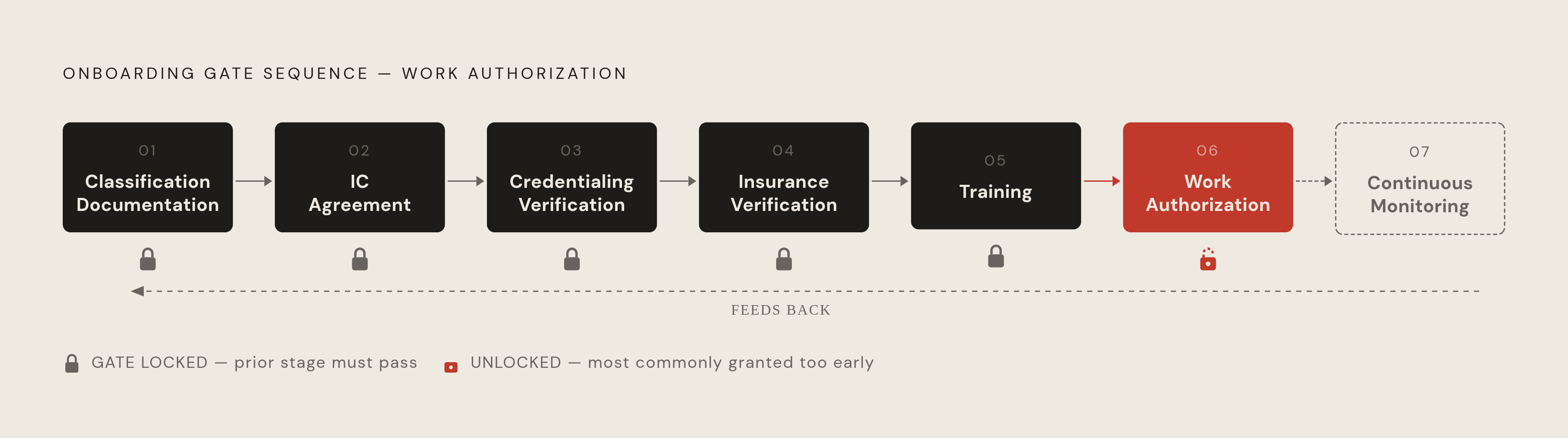
A compliance system must enforce gates so that each module passes its status check before the next activates and work authorization depends on the full sequence. Otherwise, an orderly-looking workflow can still permit the very gaps it was designed to prevent.
The operational order begins with classification documentation, which establishes the basis for the relationship. The IC agreement follows, locking in terms that reflect the classification determination. Credentialing then confirms readiness to perform delivery work, and insurance verification confirms that appropriate coverage is in place. Training provides outcome-scoped preparation after those foundations are established. Work authorization comes last, only when all five earlier modules have completed status.
After authorization, the system must shift from intake to continuous monitoring. Credentials expire, insurance lapses, agreements must be renewed, and the facts behind a classification can change. An untouched onboarding record can become an evidentiary liability. The durable foundation is therefore the connection between the original assessment, current status, and the gates that control eligibility. Automation allows those connections to hold as the network grows without requiring manual overhead to rise proportionally.
GigSafe combines its onboarding modules with credentialing, insurance, monitoring, and payments in one platform. It states that automated onboarding flows cut timelines from weeks to days, making it a relevant option for delivery operators replacing manual sequencing. For contractors, finishing onboarding should mean they can start earning quickly without waiting in another queue. Instant debit or same-day ACH payments help keep contractors and build a relationship with them as independent business partners. Fast pay completes the practical bargain that a well-designed onboarding system makes possible.