DOL 2024 Independent Contractor Rule Operational Impact
Delivery platforms face dual compliance burdens from bifurcated enforcement standards.

The DOL's 2024 independent contractor rule changed more than a form. It rewired the analytical test for who counts as an employee under the Fair Labor Standards Act, and delivery networks built on 1099 owner-operators are still absorbing the shock. The rule's private litigation tail means the compliance question is not settled, and the only durable answer is an operational discipline that survives regulatory whiplash.
Why the 2024 rule's six-factor test raised the compliance bar for IC-network operators
The rule took effect March 11, 2024, and it rescinded the 2021 rule, replacing it with a six-factor economic realities test under the FLSA. The Congressional Research Service's Legal Sidebar on the 2024 rule establishes that date and the substitution. The six factors are familiar to anyone who has defended a classification decision: opportunity for profit or loss depending on managerial skill, investments by the worker and the potential employer, degree of permanence of the work relationship, nature and degree of control, extent to which the work is integral to the employer's business, and skill and initiative.
The decisive structural shift concerned how those factors interact. Under the 2021 rule, control and opportunity for profit or loss outweighed the other factors. If both pointed the same direction, the analysis was effectively concluded. The 2024 rule assigns equal weight to all six factors, and no single factor is determinative. Every factor is now a potential liability. Two provisions exposed delivery operators directly. Written contractor agreements now demand re-examination, because the paper itself is probative.
The central question the rule revives is whether, as a matter of economic reality, a worker is economically dependent on the platform or genuinely in business for themselves. An operator whose agreements were drafted for the two-core-factor world of 2021 now faces a test where every operational choice, from safety protocols to route specifications, carries evidentiary weight. The compliance bar rose not because the factors changed, but because the margin for error disappeared.
How the enforcement landscape split into two distinct compliance risks
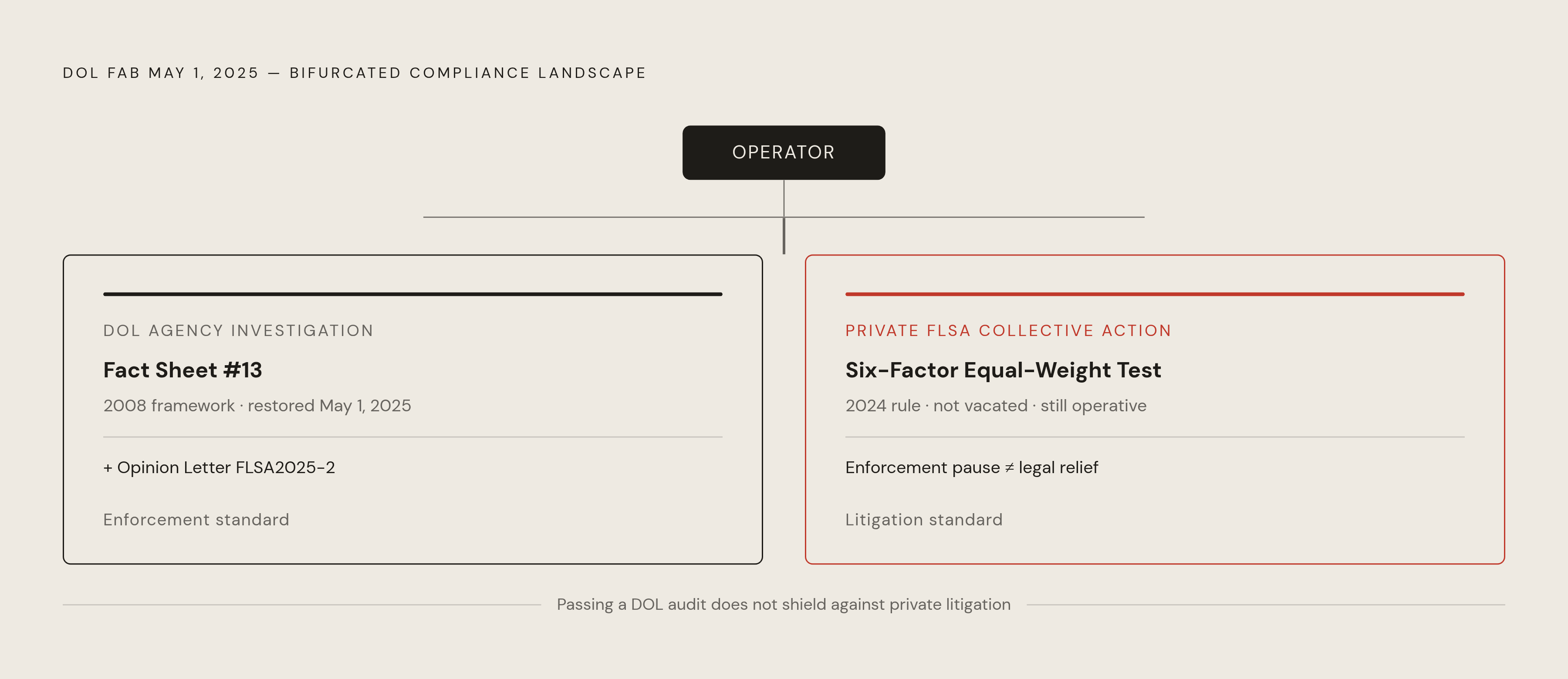
Even so, the DOL's decision to stop enforcing the 2024 rule did not erase the rule's legal force. On May 1, 2025, the DOL issued Field Assistance Bulletin No. 2025-1, which directed Wage and Hour Division field staff to stop applying the 2024 rule in agency investigations. Under the bulletin, investigators must instead apply Fact Sheet #13, the 2008 version restored May 1, 2025, and Opinion Letter FLSA2019-6, reinstated the same day and formally redesignated as Opinion Letter FLSA2025-2 on May 2, 2025. Those documents address the economic reality test as it applies to gig-economy virtual marketplace arrangements.
Jackson Lewis's May 2025 analysis of the bulletin identifies the critical carve-out. Plaintiffs' counsel in FLSA collective actions can still invoke the six-factor equal-weight framework. The rule has not been vacated by a court. It remains on the books.
The result is a bifurcated landscape. Agency enforcement follows one standard, the older Fact Sheet #13 framework. Private litigation can invoke another, the 2024 six-factor test. An operator who passes muster under Fact Sheet #13 during a DOL investigation is not necessarily protected from a private class action invoking the still-legally-operative 2024 test. The compliance question has been split in two, and each half requires its own defense.
This split is not a technical curiosity. An operator preparing for a DOL audit might reasonably rely on the 2008 guidance. That same operator, if they face a class action brought by plaintiffs' counsel, must defend against the six-factor equal-weight test. One set of records must satisfy two different analytical frameworks, and the harder one is available to private plaintiffs regardless of what the agency says. The enforcement pause was not relief. It was a complication.
What misclassification actually costs a delivery company when it goes wrong
Misclassification liability compounds across categories. Civil penalties run more than $2,300 per violation. State-level fines can reach $25,000 per worker, depending on jurisdiction. For a mid-size operator, the arithmetic is straightforward and grim.
Holland & Knight's analysis of the 2024 rule warns that the rule could lead to an influx of litigation against transportation and logistics companies by attorneys seeking reclassification and damages for overtime and deductions. If you rely heavily on 1099 owner-operators, one successful collective action can pile liability across hundreds or thousands of contractor relationships at once. Classification risk scales with contractor headcount.
The compounding effect is where the damage hides. Operators who imposed safety standards, quality controls, or customer service protocols to protect their business, and who documented them carefully, may have inadvertently built a record that plaintiffs' counsel will use to argue the control factor under the 2024 six-factor test. That is the trap at the center of the 2024 rule, and it is not theoretical. It is a liability structure waiting for a plaintiff.
Why multi-state delivery networks face layered classification exposure beyond the federal rule
Federal rulemaking shifts do not reduce a multi-state delivery operator's classification risk, whether they move toward the 2024 standard or back toward the 2021 framework. The Congressional Research Service's Legal Sidebar confirms that the 2024 rule has no effect on other federal, state, or local laws that use different standards for employee classification. State tests apply in parallel and are unaffected by DOL rulemaking.
The ABC test is the sharpest example. It imposes a presumption of employment status that requires the hiring entity to affirmatively demonstrate all three conditions. It is structurally more demanding than any version of the federal economic realities test. A delivery operator running contractor networks across multiple states simultaneously faces at least three distinct classification standards: the federal economic realities test in its current enforcement form, state ABC-test jurisdictions, and any additional state-specific frameworks. The layers are additive, not alternative.
The practical implication follows directly. A favorable federal enforcement posture is not full compliance clearance. The only coherent response is to calibrate classification discipline to the most demanding standard in each operating jurisdiction, not to whichever federal rule happens to be in force this quarter.
How the "safety compliance as control" problem forces delivery operators to rethink contractor agreements
The standard operational practices that delivery companies use to protect their business are exactly the practices that create classification vulnerability under the 2024 rule's control factor. Holland & Knight identifies the tension directly: actions to ensure compliance, safety, quality control, and contractual or customer service standards may be indicative of control under the 2024 rule, a result that conflicts with court decisions previously finding those actions reasonable and justified. The reserved control problem deepens the exposure. Standard contract boilerplate that reserves rights over how work is performed becomes evidence of employee status even when day-to-day operations look nothing like an employment relationship. The 2026 proposed rule offers a partial fix. The operational necessity of detailed protocols is highest precisely where the classification risk from those protocols is also highest.
The answer is not to strip out safety standards. The answer is to structure documentation, agreements, and contractor relationships in ways that reflect genuine independence. The problem is that their paper makes the relationship look like employment when it is not.
Why real-time compliance monitoring is more defensible than periodic audits under any version of the economic realities test
The economic realities test, in any of its forms, is evaluated on the totality of circumstances as they actually exist. That means classification status is not binary and fixed. It is a continuous condition that changes as the relationship evolves. The multi-factor structure of the 2024 rule, and the totality-of-circumstances approach that both the 2008 Fact Sheet and the 2024 rule share, makes that explicit. A periodic audit that certifies compliance at one moment cannot protect an operator when the relationship drifts between audits.
The drift is not hypothetical. Each of those changes alters the six-factor analysis. None of them announces itself.
Continuous compliance status monitoring creates a contemporaneous record that documents contractor independence at the time decisions are made, not retroactively. When compliance status flows into dispatch decisions automatically, only qualified contractors get routes matching their certifications, which produces operational efficiency and a defensible compliance record simultaneously. The architecture does the work.
How onboarding speed and credential verification function as classification risk controls
Onboarding is the moment when contractor independence is either documented or left ambiguous. The thoroughness of credential verification at that stage directly affects classification defensibility for the entire subsequent relationship. Control: a well-structured onboarding process that presents the contractor as a self-directed business entity, rather than a worker being fitted into a company's operating system, shapes the nature of the documented relationship from the first interaction.
In compliance-sensitive delivery categories, training requirements compound. HIPAA protocols, bloodborne pathogen certification, and hazmat handling create onboarding workflows that must be completed before routes can be assigned. Onboarding timelines that compress from weeks to days reduce that dropout risk while ensuring the compliance record is complete before dispatch. Airspace, a time-critical logistics company operating in organ transport and urgent shipments, treated rapid onboarding of credentialed drivers as a non-negotiable operational requirement. Its quality sets the evidentiary baseline for everything that follows.
Why the contractor insurance stack is both a compliance requirement and a classification signal
The insurance arrangements an IC-network operator makes for its contractor workforce function simultaneously as a coverage decision and as evidence bearing on the economic realities test. Workers' compensation is state-mandated and generally limited to employees. Independent contractors are typically ineligible, but significant state-by-state exceptions exist. Nevada, Florida in construction, and Louisiana for manual labor mandate or permit workers' comp coverage for certain contractors, and eligibility is determined by multi-factor classification tests, not W-2/1099 tax status alone. Occupational accident insurance, occ/acc, is the appropriate coverage instrument for 1099 contractor workforces, providing medical expense coverage, disability income, accidental death benefits, and accidental dismemberment benefits for work-related injuries. Misclassification creates an insurance gap that materializes at the worst moment. After an accident, evidence of delivery activity, app data, cargo in the vehicle, witness accounts, triggers a denial of the personal auto claim, leaving the driver financially exposed and creating liability for the operator who relied on that coverage.
Commercial auto liability, cargo coverage, general liability, and occ/acc insurance make up the core coverage stack for last-mile delivery operations. Each layer addresses a different exposure, and gaps in the stack are exposed during regulatory review or litigation. The insurance stack is not a separate operational topic. It is classification evidence.
How payment speed and automated settlements connect to classification defensibility
Payment architecture is simultaneously a classification risk factor and a competitive tool. The economic dependence question at the center of every version of the economic realities test turns in part on whether a contractor's financial circumstances tie them to a single platform. A contractor waiting on a weekly cycle is a contractor who cannot easily diversify.
Automated per-delivery settlement with clean, auditable 1099-NEC generation serves a dual function. It provides contractors with timely, transparent compensation that reflects the structure of an independent business relationship, and it produces documentation that demonstrates the arms-length financial character of the engagement. Fast pay, instant debit or same-day ACH, reduces contractor reliance on a single platform because they can access earnings immediately and manage their own business cash flow. A contractor who is not financially trapped waiting for a payment cycle is more plausibly operating an independent business.
Manual settlement processes create documentation gaps. Payment speed is not a perk. It is a structural feature of a defensible independent contractor relationship.
What an ongoing classification discipline looks like as an operational practice
The regulatory whiplash pattern is now established. The only durable posture for an IC-network operator is a continuous operational discipline, not a rule-by-rule compliance response. The practices that make a classification defensible under any version of the economic realities test are not rule-specific. Real-time compliance monitoring that tracks credential status, engagement patterns, and contract terms continuously, not at annual audit intervals.
Insurance architecture must match contractor status: occ/acc coverage appropriately structured, personal auto gaps addressed, coverage documented at the contractor level. The multi-state dimension means you must keep this discipline up against multiple standards at once. Federal economic realities tests and state ABC tests do not resolve to a single threshold, so the discipline must be calibrated to the most demanding applicable standard in each operating jurisdiction.
Operators who embed this discipline into their platform infrastructure, instead of relying on periodic legal reviews, can scale contractor networks without adding back-office overhead that grows with contractor headcount. Classification rigor, done as an operational practice, is not a compliance cost center. It is the infrastructure that lets a delivery network grow without accumulating the latent liability that will be measured, at the worst possible moment, by whichever standard a plaintiff chooses to invoke.
Sources
- Department of Labor’s 2024 Independent Contractor Rule
- Businesses Get a Break: DOL Won’t Enforce 2024 Independent Contractor Rule - Jackson Lewis
- Department of Labor (DOL) January 2024 Ruling: Understanding its Implications on Independent Contractors and Industries Like Trucking Who Rely Largely on 1099 Owner Operators