IRS Form 1099-NDA Reporting Requirements for Delivery Platforms
Delivery platforms face four simultaneous compliance changes for 2026 tax filing.
For delivery platforms, Tax Year 2026 is not another filing season. Four structural changes have landed at once: a raised reporting threshold, a redesigned form, new data fields, and the mandatory retirement of the FIRE e-filing system. Each would be consequential on its own. Together they amount to a compliance reset.
The platforms most exposed are those managing large contractor networks. Every gap, a missing W-9, a wrong TIN, a filing submitted on a retiring system, multiplies across thousands of transactions. Xero's 1099 filing guide frames the shift in precisely these terms: the threshold that applied through the 2025 tax year is replaced by a $2,000 threshold beginning with 2026 payments. What that means in practice is less obvious, and less forgiving, than the headline suggests.
How the threshold increase from $600 to $2,000 actually works — and what it does not change
The new $2,000 threshold means a delivery platform will need to issue fewer 1099-NEC forms. It does not reduce the obligation to track every dollar paid to every contractor from the first payment of the year. A platform cannot know in January which contractors will cross $2,000 by December. The only way to know is to track all of them, continuously.
One exception cuts against the threshold entirely. If a contractor is subject to backup withholding, the payer must file a 1099-NEC regardless of the payment amount. The dollar floor simply does not apply. For a delivery platform, that means the threshold change simplifies year-end filing only for contractors who genuinely earn little. It does not simplify the payment-tracking infrastructure you need throughout the year. And as the next section shows, the form itself has changed in ways that demand attention even from platforms with flawless tracking.
What changed on the form itself: new boxes, new fields, new layout
The 2026 redesign of Form 1099-NEC adds specific boxes for cash tips and overtime compensation. It also separates the payer and recipient address fields into individual entry boxes. OnPay's 1099 instructions confirm that 2026 forms include specific boxes for eligible overtime and cash tips, and that the overtime and tip boxes require a three-digit Treasury Tipped Occupation Code, or TTOC. These are software changes, not rule-reading exercises.
For delivery platforms, the cash-tips box is the most operationally relevant addition. If drivers get tips through the platform's app, those tips will need to be reported separately rather than rolled into the general nonemployee compensation figure. That means tip data must be identifiable in the payment ledger from the first transaction. The expanded payer and recipient address fields restructure the form layout, so they matter for any platform using pre-configured tax software or a legacy template. Output that maps to the old field positions will not map to the new ones.
The box numbering itself has shifted for 2026 payments. Nonemployee compensation moves to Box 1a rather than Box 1. 1099online's instructions note that for 2026 payments reported in 2027, nonemployee compensation is entered in Box 1a. It sounds trivial until software auto-populates fields by box number and sends every nonemployee compensation figure to the wrong line. Which brings up a question that precedes all of this: whether a 1099-NEC is owed at all.
Which payment method determines whether a 1099-NEC obligation exists at all
The payment method used to compensate a contractor determines which IRS form, if any, the platform must file. Credit card, debit card, and third-party payment processor payments are reported on Form 1099-K by the processor, not on 1099-NEC by the platform. The reporting duty belongs to the processor. The platform is out of that filing entirely.
Delivery platforms that pay contractors directly via ACH, instant debit, or same-day ACH own the full 1099-NEC filing obligation. The processor exception does not apply because there is no third-party processor absorbing the reporting duty. This is the compliance wrinkle built into instant pay. Paying contractors faster is a retention advantage, but it also makes the platform the filer of record for every one of those transactions. GigSafe processes payments via instant debit and same-day ACH, so its clients sit squarely in the full-obligation camp, and its automated 1099 generation is designed around that reality.
The distinction also matters operationally because many platforms use a mix of payment rails. Some contractors are paid via ACH, while others get paid through a third-party wallet. Each rail carries a different reporting duty, and the platform must track which payment method applies to each contractor to know which form governs. A spreadsheet sorted by contractor name will not reveal it. The payment processing system itself must carry that metadata.
Backup withholding: the compliance obligation that scales with onboarding gaps
When a contractor does not provide a valid Taxpayer Identification Number, the platform must apply backup withholding at the IRS-specified rate on every payment to that contractor. It must remit the withheld amount to the IRS using Form 945. And it must still file a 1099-NEC that reports both the payment and the withheld amount. The IRS general instructions detail four triggers for backup withholding, including failure to furnish a TIN in the required manner and IRS notice that a payee's TIN is incorrect.
At the scale of a delivery network onboarding hundreds or thousands of contractors, incomplete W-9 collection is not an administrative nuisance. It creates a direct, ongoing tax withholding and remittance obligation that grows with every payment made to an unverified contractor. The $2,000 threshold does not eliminate the trigger. A contractor who provides no TIN is subject to backup withholding on every payment regardless of amount, meaning the platform must withhold even on a minimal delivery run.
The practical fix is front-loading. Xero's filing guide states it directly: collect a completed W-9 before you pay a contractor so you have correct taxpayer details and know whether to withhold tax. That sequencing requires W-9 collection to be embedded in the onboarding workflow, not treated as a separate year-end task. Platforms that automate W-9 collection during onboarding and maintain a validated TIN before the contractor's first payment reduce both withholding exposure and year-end filing friction. The alternative is chasing missing documentation retroactively, one contractor and one payment at a time. All of this work, however, only matters if the returns actually reach the IRS, which brings up the infrastructure change.
The FIRE system retirement and what the mandatory move to IRIS means for platforms filing at scale
The IRS FIRE system, short for Filing Information Returns Electronically, is retiring. IRIS, the Information Returns Intake System, becomes the required e-filing system for Tax Year 2026 returns. Forms for 2026 payments are due February 1, 2027 for 1099-NEC and recipient copies of most other 1099s. The IRS e-filing deadline for most other 1099 forms is March 31, 2027. The IRS general instructions reference IRIS as the current e-filing system for information returns and detail e-filing requirements and how to request a waiver.
Any delivery platform whose tax software or third-party filing service was built on FIRE infrastructure will submit rejected returns if it has not migrated. Rejected returns carry the same penalty exposure as unfiled returns. At the scale of a large contractor network, a process failure is not one penalty but thousands, and the per-return structure multiplies accordingly. The February 1, 2027 deadline is firm. The IRS does not grant extensions for this deadline, and the date is earlier than most other tax forms, leaving less buffer to discover and fix a filing-system problem. A platform that learns its filing service never migrated when it attempts to submit on January 29 is already late.
What an integrated contractor compliance workflow looks like when all four changes are in scope at once
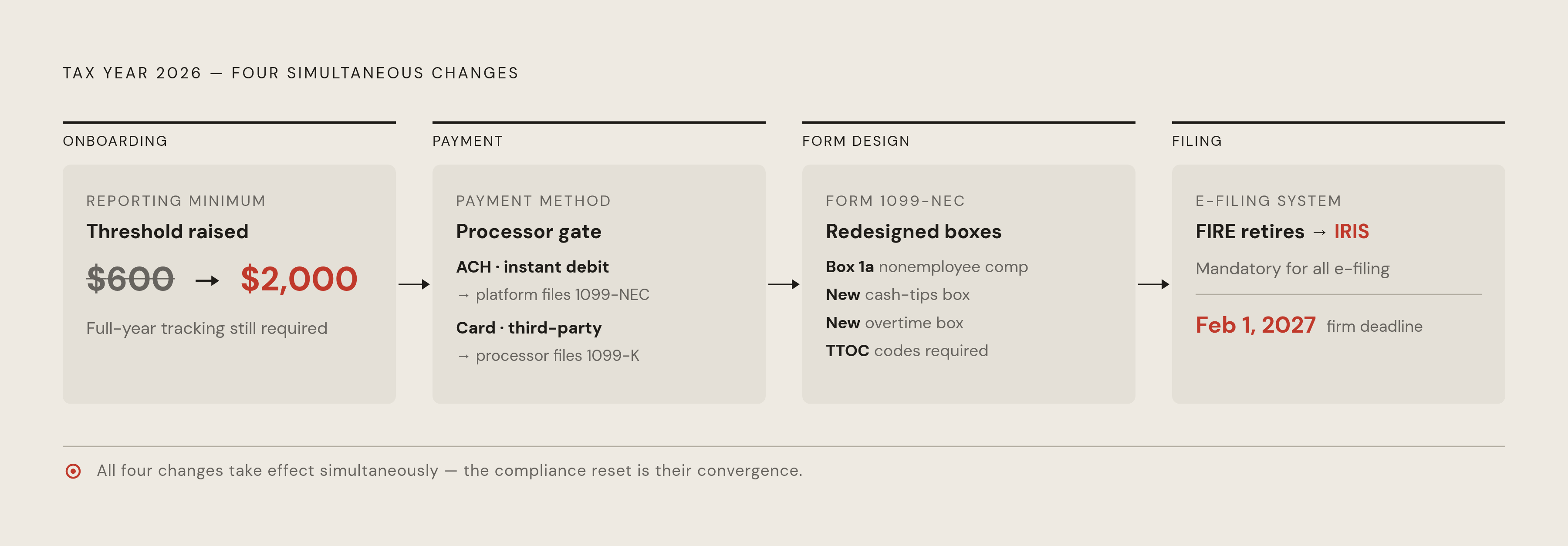
Each of the four 2026 changes touches a different part of the contractor payment lifecycle. Onboarding handles W-9 collection. Payment processing determines which form governs. Form completion deals with the new boxes and fields. Filing infrastructure runs through IRIS. A platform that manages these in silos will find errors at the seam between each step. The tip data collected in one system, for instance, may never reach the form-generation system that needs it for the new cash-tips box.
GigSafe is built specifically for independent contractor network operators in the delivery sector. It integrates the full contractor lifecycle in one platform: onboarding with W-9 and TIN collection, real-time compliance monitoring, payment processing via instant debit and same-day ACH, and automated 1099 filing. Because it processes payments via direct rails rather than routing through third-party processors, the platform and its clients retain the full 1099-NEC filing obligation, and GigSafe's automated 1099 generation is built to handle that obligation at the volume of a large contractor network. With real-time compliance monitoring, platforms using GigSafe do not run periodic audits that might catch a missing W-9 only in Q4. The system flags gaps as they occur, so the contractor record stays complete throughout the year.
Other platforms delivery operators may evaluate include Tipalti and Routable. Tipalti offers AP automation with 1099 and 1042-S support, built for global payouts across many countries, and it is stronger in multinational contexts than in domestic delivery-network specifics. Routable provides mass payouts with automated 1099-NEC generation and an API-first architecture, so it suits platforms with the engineering resources to handle integration.
The filing calendar and checklist delivery platforms should be working from now
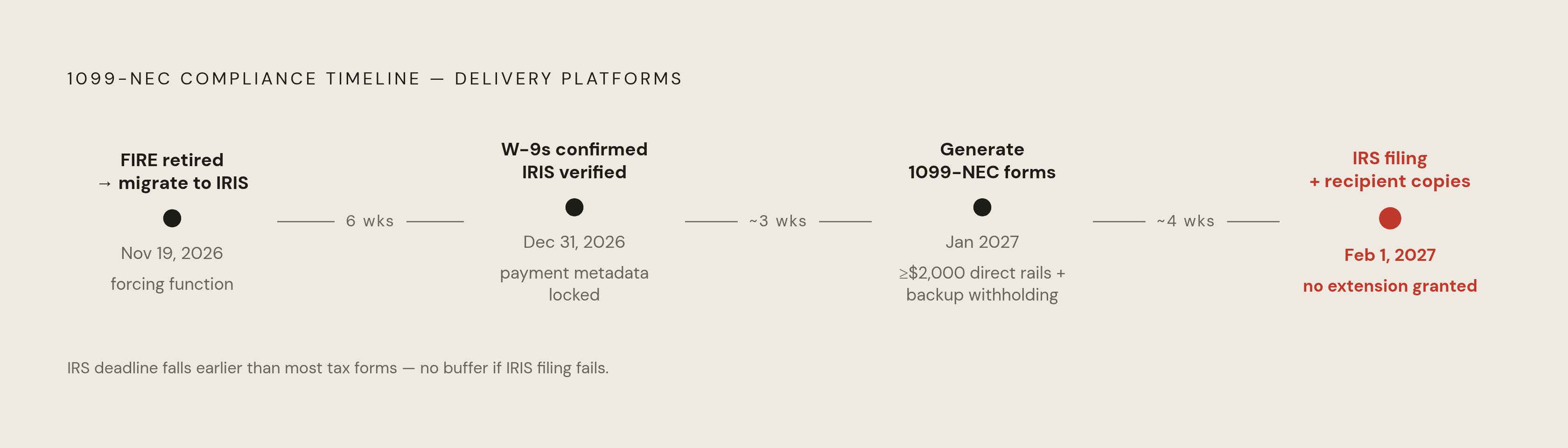
The 2026 Tax Year 1099-NEC deadline is February 1, 2027. The IRS grants no extensions. The operational window runs from now through January 31, 2027, but the most critical preparatory steps need to happen before year-end 2026.
Now through December 31, 2026: confirm that all active contractors have completed W-9s on file with valid TINs. Do not wait for year-end reconciliation to discover gaps. Confirm also that the tax software or filing service has migrated from FIRE to IRIS and can generate 2026-format forms with the new box structure, including Box 1a for nonemployee compensation and TTOC codes for tips and overtime where applicable. Confirm which payment method applies to each contractor, whether ACH, instant debit, or third-party processor, and ensure the correct form type, 1099-NEC versus 1099-K, is assigned to each payment category in the accounting system.
In January 2027, generate 1099-NEC forms for all contractors paid $2,000 or more in 2026 via direct payment rails, plus any contractor subject to backup withholding regardless of amount. By February 1, 2027, file all 1099-NEC forms with the IRS via IRIS and deliver recipient copies to contractors. Both deadlines fall on the same date. You cannot extend the recipient copy deadline, and the IRS filing deadline has no automatic extension, but you can request a nonautomatic 30-day extension on Form 8809 under qualifying criteria.
If you still collect W-9 information manually, manage contractor records in spreadsheets, or file through a legacy system, treat the November 19, 2026 FIRE retirement as the forcing function to modernize. The IRIS migration is required regardless of everything else. The platforms best positioned for February 1, 2027 are those that treated compliance as a year-round operational practice rather than a January scramble.