ABC Test vs. Economic Reality Test by State
States apply conflicting employment tests to the same delivery driver.
No single rulebook decides whether a delivery driver is an employee or a contractor. A federal common-law test for tax purposes, a labor agency's economic-reality test for wage-and-hour law, and whatever ABC or common-law standard the worker's state has adopted for unemployment insurance, workers' comp, and state wage claims can all apply to the exact same worker at the exact same time. A signed 1099 form doesn't settle any of it. What settles it is how the relationship actually runs, day to day, and that record can say "employee" under one test and "contractor" under another, for the same person, on the same route, on the same Tuesday.
California makes the point in statute. A driver can pass the federal common-law test with room to spare and still fail Prong B of a state's ABC test, codified in that state's labor statutes. Lab. Code §2775, on the same afternoon. Two federal and state agencies looking at identical facts and reaching opposite conclusions is the design. Two federal and state agencies looking at identical facts and reaching opposite conclusions is the design. For delivery companies and independent-contractor network operators running in a dozen states at once, that design means a company can genuinely believe it's compliant and still be wrong in three different courtrooms simultaneously.
What the DOL economic-reality test requires as of late 2026
The federal test, laid out at 29 CFR §795.105(b), asks one question: is the worker, as a matter of economic reality, running their own business, or are they economically dependent on the company that hired them? Six factors feed that answer, and the DOL treats it as a totality-of-circumstances call in which no single factor wins the case.
Whether the worker can actually profit or lose money through their own decisions (negotiating rates, picking jobs, managing costs), how much the worker has sunk into their own equipment, insurance, and tools relative to what the company has invested, whether the relationship is a one-off gig or an indefinite, ongoing arrangement, who controls the schedule and pricing and whether the worker can freely drive for a competing app, whether the work sits at the core of the company's business, and how much independent skill and initiative the worker brings to it are all worth documenting no matter which rule ends up governing. Reserving the right to control someone counts against a company even if that right never gets exercised. Nobody has to actually pull the leash for a court to notice it's there.
The current regulatory situation is genuinely strange. A recent federal rule, with its six-factor test, is still the operative text sitting in the federal regulatory code. But DOL Field Assistance Bulletin 2025-1 told investigators to stop applying that standard and go back to the economic-reality framework from Fact Sheet #13. Then, on February 27, 2026, a federal labor agency published a proposed rule in the federal register. Reg. 9932) to formally kill the 2024 rule and replace it. The comment period closed April 28, 2026. No final rule has landed yet. So the rule on the books and the rule investigators actually use are two different documents, and the whole thing is still in the mail.
Why Prong B of the ABC test is nearly fatal for delivery platforms
Every version of the ABC test starts from a presumption that hurts: the worker is an employee unless the hiring company proves otherwise, and it has to prove all three prongs. Not two out of three. All three, independently:
- A: the worker is free from the hiring entity's control in doing the work
- B: the work falls outside the hiring entity's usual course of business
- C: the worker is customarily engaged in an independently established trade or business of their own
Missing one prong makes the worker an employee under that test. The facts on the other two prongs stop mattering the moment the first one fails. Courts don't average the score.
That structure is why Prong B is close to a death sentence for delivery platforms. If a company's business is delivery, and the person it contracted with is delivering, the work is not outside the usual course of the company's business. It's the business. No amount of scheduling flexibility, no contractual language calling someone an "independent logistics partner," changes that math. A delivery company trying to satisfy Prong B for its delivery drivers is a bit like a bakery trying to argue that baking bread isn't really part of what it does. Nobody buys it, least of all a labor commissioner.
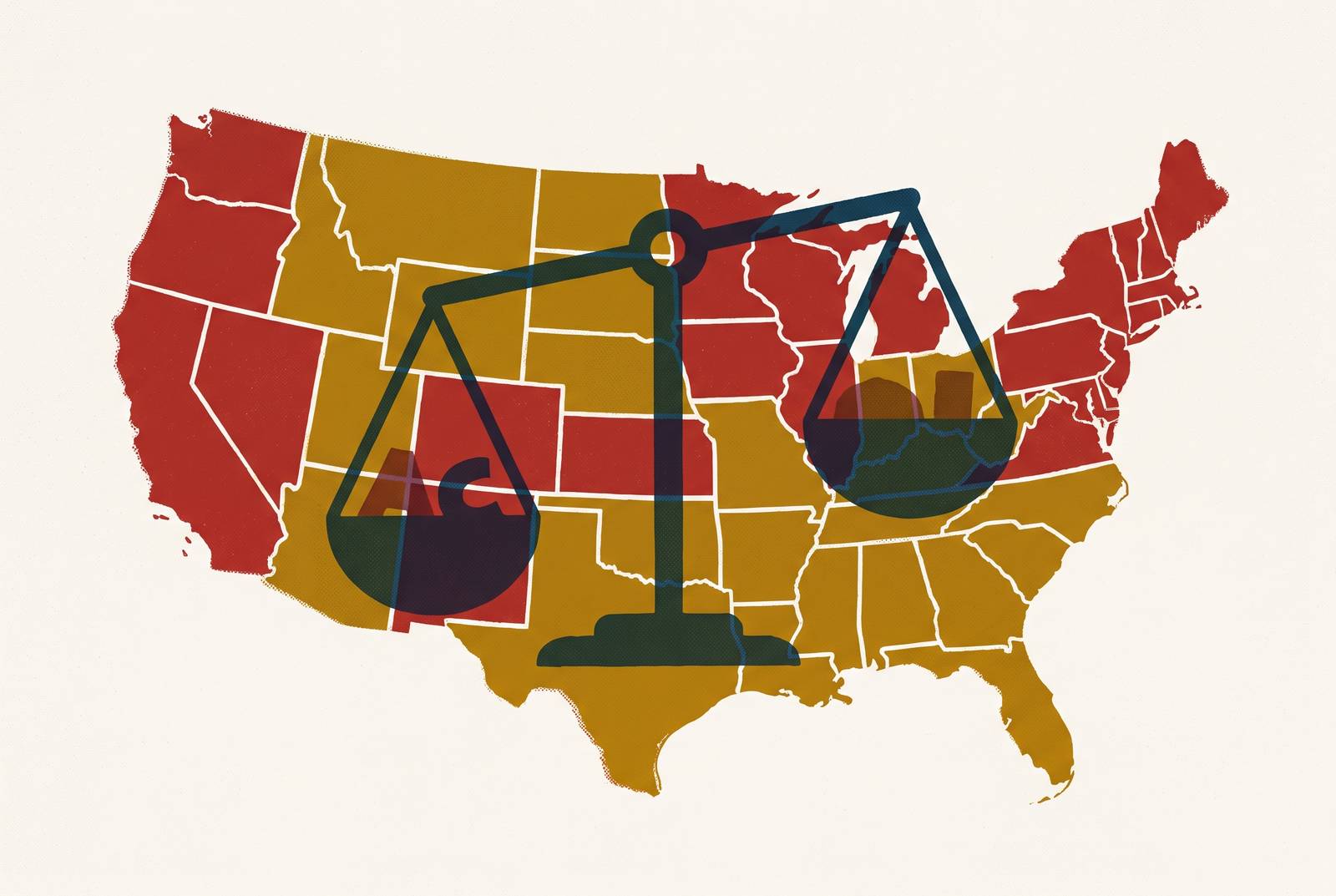
The state map showing which test applies where and what operators must know about each tier
As of September 17, 2026, 26 of the 51 states and territories. jurisdictions apply an ABC test for at least some purpose, and 6 apply it broadly across wage-and-hour and unemployment insurance both.
Tier 1, strict and broad ABC, the highest-risk group for delivery operators:
One state's labor code. Labor Code §2775 et seq., the Dynamex/AB5 line) applies ABC to most wage-and-hour claims and unemployment insurance. Statutory exemptions fall back to the older Borello multi-factor test, and AB 1514 narrows exemptions for certain professionals. Proposition 22 carves out an exception, but only for app-dispatched platform work, not for the industry generally.
Another state's general laws. c. 149 §148B) runs a strict three-prong test and applies it to most wage-and-hour law plus unemployment. The state has pursued enforcement actions against gig platforms and still applies its own ABC test to gig workers regardless of what California decided with Prop 22. That carve-out does not travel across state lines.
A third state's statutes. A subsection of that state's administrative code applies ABC to unemployment insurance, wage-and-hour claims, and wage payment law, with a companion administrative rule. 12:11 taking effect October 1, 2026. New Jersey is widely regarded as one of the most aggressive enforcement states in the country.
Illinois runs ABC for unemployment insurance (820 ILCS 405/212) and a related ABC-based test for construction under the Employee Classification Act (820 ILCS 185). Oregon uses a modified ABC test under ORS 670.600, applied to unemployment and workers' comp, with wage-and-hour claims evaluated under a separate standard. Another state applies ABC to unemployment insurance under its own labor statutes. its own unemployment insurance statute and a separate wage-payment provision.
Tier 2, ABC or modified ABC limited to unemployment insurance:
Alaska, Colorado, Connecticut, Delaware, Hawaii, Indiana, Kansas, Louisiana, Maryland, Nebraska, Nevada, New Hampshire, New Mexico, Ohio, Oklahoma, Pennsylvania, Rhode Island, Utah, Washington, and West Virginia all sit here. Maryland layers on separate Workplace Fraud Act provisions specific to construction and landscaping. Another state runs a two-part test under its own revised statutes. Rev. Stat. §8-70-115, dropping the usual-course-of-business prong entirely and asking only whether the worker is free from control and customarily engaged in an independent trade related to the service performed. Pennsylvania runs a loosened modified ABC for UI purposes only. Oklahoma and Virginia use an AB/AC variant, where a worker can qualify under Conditions A and B or Conditions A and C, giving companies more room than a strict ABC test allows.
The narrower scope here doesn't mean lower stakes. Misclassification in a UI-only ABC state still triggers retroactive unemployment insurance back contributions, and reclassified workers gain retroactive access to paid family leave, sick leave, and unemployment benefits they'd otherwise have been locked out of.
Tier 3, common-law right-to-control or economic-realities as the default:
Texas, Florida, Georgia, Arizona, and New York (a hybrid case; the Industrial Commissioner has issued guidance applying Matter of Vega to app-based delivery specifically) all fall into this group. These states lean on behavioral and financial control, an analysis that tracks much closer to the IRS common-law test than to any ABC framework. Texas and Florida are the friendliest ground in the country for 1099 delivery networks, though federal FLSA exposure doesn't disappear just because state law is lenient. 22% of workers in Florida do gig work, the highest concentration of any state in the country, which makes getting classification right there an operational question, not just a legal one, so Florida is worth watching closely on its own.
What multi-state operations mean for a delivery company's compliance exposure
Running drivers in California, New Jersey, and Texas at the same time means three different tests, three different enforcement agencies, and three different penalty structures all apply to the same fleet simultaneously. Passing muster in one state buys nothing in the next one over.
The most common mistake in the industry is stretching Prop 22's logic past California's border. Massachusetts and New Jersey run their own strict ABC tests regardless of what California decided about app-dispatched platforms, and assuming otherwise is how a company ends up with a reclassification claim it didn't see coming.
The written IC agreement is another trap. Every multifactor test, ABC or economic-reality, treats the contractor agreement as one input among several. Daily direction, fixed hours, exclusive engagement, company-issued phones and gear: actual practice overrides the paperwork in every state, no exceptions.
And passing the IRS test proves less than it looks like it proves. A Texas-based operator with California drivers can sail through the IRS common-law test and still get sunk on Prong B in California, and the state back-assessment usually dwarfs the federal one. That's because California's Labor Commissioner and the state's plaintiffs' bar reach further into a company's operations, in most fact patterns, than the IRS ever does.
The financial cost of getting it wrong: penalties, settlements, and enforcement trends by state
Misclassification doesn't cost a company one fine. It costs several, from several directions, at once: federal income-tax withholding penalties under IRC §3509, FICA and FUTA exposure, state unemployment insurance back assessments, state wage-payment claims, and private collective actions, each one running on its own separate track.
California's statutory penalty tops out at $25,000, and that's before PAGA representative-action exposure multiplies it across every similarly situated driver in the network, turning one violation into a class-sized bill. The IRS runs a penalty structure that scales with the severity of the misclassification, and willful cases carry a longer retroactive exposure period. In the worst case, the IRS can claim 41.5% of a worker's earnings in back taxes.
Up to 30% of employers misclassify workers, according to the same estimates that show why the practice persists: getting the label wrong saves a company 20% to 40% on labor costs, and that savings comes directly out of the protections, benefits, and legal recourse the worker would otherwise have.
Building a classification compliance infrastructure that holds up across multiple states
Classification facts move. A driver relationship that clears every test on day one of onboarding can fail it eighteen months later once routes get standardized, a company-issued app starts assigning jobs instead of the driver picking them, and exclusivity creeps in through scheduling pressure nobody wrote down anywhere. An audit run once a year catches none of that drift. Monitoring built to run continuously catches it while it's still small.
A compliance setup that actually holds up starts with onboarding documentation built to capture all six DOL economic-reality factors and all three ABC prongs at once, not just whichever test happens to apply in the state where the paperwork gets signed. From there, the file needs to track the same facts as they change: who's setting the hours this month versus six months ago, what tools the company is supplying versus what the worker bought themselves, whether the worker is still free to drive for a competing platform or whether exclusivity has quietly become the norm. States don't coordinate with each other on enforcement, and they don't need to. Each one runs its own test against its own facts, and a company operating in a dozen states is running a dozen separate exposures at once, whether or not anyone back at headquarters is tracking them that way.
Sources
- Independent Contractor Rules by State: ABC Tests and Risk
- worldpopulationreview.com
- DOL proposes new independent contractor rule | Nixon Peabody LLP
- DOL’s Proposed 2026 Independent Contractor Rule: What Employers Need to Know - Jackson Lewis
- DOL Seeks To Reinstate “Economic Reality” Test for Independent Contractor Classification | CDF Labor Law LLP
- worksuite.com
- ogletree.com
- beancount.io