Worker Misclassification Risk Scoring for Contractor Populations
A framework for measuring contractor misclassification risk across entire workforces.
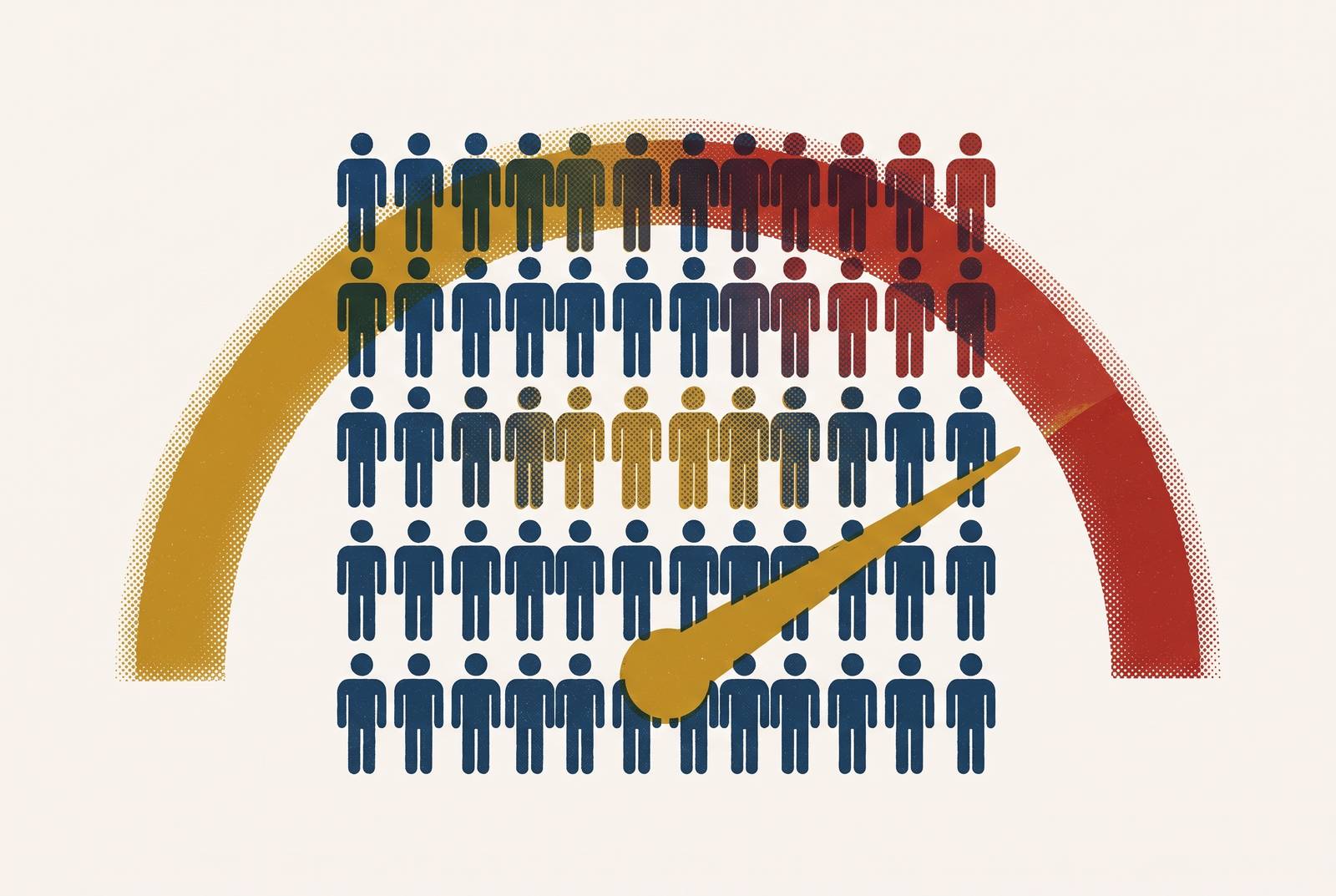
Worker misclassification risk scoring helps delivery companies spot risk in their contractor relationships before it leads to liability across the workforce. The model weights how work is done against the federal and state tests that apply, then updates scores as those practices change. GigSafe is one software option for collecting onboarding and monitoring data that supports this process, but compliance with worker classification law depends on the working relationship.
Why misclassification risk is harder to manage at population scale than it looks case by case
Companies often review contracts one at a time to manage classification, but the evidence that matters is in how they dispatch work, pay contractors, and supervise them each day. A contractor hired for a fixed project can become dependent on one platform, follow company-dictated methods, and perform work central to its business. None of those changes requires a new agreement. The IRS three-category framework, the DOL economic-reality analysis, and state ABC tests look at how the relationship works in practice. The contract is evidence.
That gap becomes harder to see when a contractor population reaches hundreds or thousands. A legal team that reads agreements one at a time sees what the documents say but misses patterns in how work is done across the network. Periodic review may capture a relationship at one moment without revealing how the same practice is changing many others. When the same classification mistake is repeated across the workforce, the errors are linked and become a compliance failure across the workforce.
The pattern is also what makes the exposure attractive to enforcement agencies and plaintiffs' counsel. If the same dispatch rule or payment structure affects a whole class of drivers, the issue is bigger than one poorly drafted agreement. Case-by-case review can examine individual facts, but it cannot, on its own, show the distribution or movement of risk.
The regulatory environment companies are scoring against in 2026
The DOL's 2026 Notice of Proposed Rulemaking proposes an economic-reality analysis that gives particular weight to control and opportunity for profit or loss. The DOL's 2024 rule and proposed 2026 framework both consider permanence of the working relationship, but the proposed weighting changes the federal scoring context. Operators must account for that uncertainty while maintaining the applicable standard.
Separately, the IRS common-law framework evaluates behavioral control, financial control, and type of relationship. State rules operate on their own track, including California's ABC test, Arizona's Declaration of Independent Business Status framework, and Texas's common-law right-to-control test. A driver who satisfies a federal economic-reality analysis can still fail California's ABC test. California's test applies to work performed in California regardless of where the company is headquartered.
The Darden test under ERISA, state unemployment tests, and state workers' compensation tests can also apply for different purposes. A scoring model therefore needs to flag exposure under the most demanding applicable test. For multi-state operators, encoding state-specific and federal requirements simultaneously is a data-management task as well as a legal one. Contractor platforms, including GigSafe, are relevant to that infrastructure problem, but the scoring logic still has to reflect each applicable framework.
The three axes every misclassification risk score must measure
The IRS categories provide a useful structure for translating legal questions into observable facts. The three axes are behavioral control, financial control, and relationship structure. They organize the evidence without making the legal tests interchangeable. Each axis asks a different question about whether the contractor is operating an independent business or functioning as an employee.
Behavioral control measures who determines how work gets done. The score rises when the company sets schedules, requires tools and internal meetings, and tells contractors which order to do the work in. For delivery operators, control is visible in tightly assigned routes and delivery windows, company apps that drivers must use, and tracking of drivers mile by mile. Contractor-chosen schedules, their own equipment, and discretion over methods point in the other direction.
Financial control measures whether the contractor has a genuine opportunity to profit or lose through business decisions. Salary-like guaranteed payments, exclusivity, full expense reimbursement, and little room for initiative indicate dependence. Contractors show more independence when they are paid by the delivery, are responsible for their expenses and equipment, and work for more than one client. The DOL's proposed 2026 framework makes opportunity for profit or loss one of two core considerations, giving this axis particular federal significance.
Relationship structure measures the engagement's scope, duration, and resemblance to employment. Concern rises when renewals have no set end, contractors get benefits like employees and appear in internal directories, and their work is central to the business. Contractors show signs of independence when they have defined deliverables and fixed terms, send invoices, and do work outside the business's core operations. Last-mile delivery operators face an obvious constraint here because drivers often provide the service the business sells, leaving the other axes as the main levers for reducing risk.
How to weight the factors and translate them into a composite score
Begin by assigning each observable indicator to its axis, then weight it according to the applicable legal test. Within behavioral control, the highest weight goes to the company's control over how work is done and when. Within financial control, salary-like compensation and exclusivity carry the highest weight because they signal dependence. Within relationship structure, the highest weight goes to engagements that have no defined scope and stay open-ended or keep renewing with no set end. These priorities make the model more than a tally of equally important boxes.
Next, assign point values based on how much control there is. For example, company control of methods and schedule can receive the highest point value, shared control a middle value, and full contractor control zero. Summing the weighted values across the three axes produces a composite score. Those values are illustrative scoring choices. Their purpose is to make comparable facts produce comparable results.
Then translate the score into low, moderate, and high bands. Relationships in the low band need their documents reviewed, those in the moderate band need changes to how they are set up, and those in the high band need immediate remediation or reclassification review. Apply the jurisdiction-specific weighting before deciding which band governs the response. A relationship that is moderate under the federal analysis may be high under California's ABC test, so the model should report the highest applicable score. A national average is little comfort when the work occurred in the state where the relationship fails.
The drift problem and how relationships move up the risk scale without anyone deciding to change them
When a seasonal contractor is kept on with no set end, the relationship loses the defined endpoint that supported its original classification. As dispatching becomes more restrictive, the driver's discretion narrows and the behavioral-control score rises. If delivery volume makes other clients impractical, financial dependence can grow without an exclusivity clause. Performance reviews can then add an employee-management pattern to the relationship. Each change may look routine on its own, even as the changes together move the relationship into a different risk band.
That is why a periodic audit is an incomplete monitoring system. Enforcement agencies and plaintiffs' attorneys examine how the relationship actually operated over time. A correctly classified engagement that later drifts can create retrospective liability for the intervening months.
Continuous observation and rescoring at defined intervals address different parts of that problem. Observation tracks changes in how work is done, while rescoring uses the same weighted framework used at onboarding. Rescoring triggers should include changes in dispatch methods, platform tooling, payment structure, engagement duration, and expansion into new operational functions. Workforce platforms designed for contractor populations can detect behavioral and financial drift across thousands of engagements in real time, rather than leaving legal teams to reconstruct it from contracts. When onboarding, dispatching, payment, and monitoring data are connected, schedule autonomy, tool use, expenses, and profit-loss dynamics become live inputs.
What high-risk scores should trigger in practice
A high score starts a defined response. The response begins by assessing whether the actual working relationship can change. Schedule-based dispatch assignments can become delivery-window options that contractors select, reducing company control. Guaranteed minimums can become delivery-based compensation that reflects a real opportunity for profit or loss. Open-ended engagements can have fixed terms, a defined scope, and clear decisions about renewal, and contractors must be free to work for competitors in practice, with that freedom documented.
If the relationship cannot be restructured sufficiently, the score should prompt reclassification review. Documentation follows the structural assessment because an agreement should describe the working relationship that exists. Invoices from contractors, consistent treatment of similar workers, consistent 1099 reporting, and evidence that contractors run independent businesses help record the basis for classification. IRS Revenue Procedure 2025-10 clarified and updated Section 530 safe-harbor requirements, including consistent reporting, consistent treatment, and a reasonable basis. Documentation can support that defense, but a lower score alone does not establish eligibility for relief.
Insurance review comes third, with a close look at whether the coverage fits the classification the company is defending. Prop 22 establishes OAI as the statutory standard for app-based rideshare and delivery contractors in California. The California Supreme Court upheld Prop 22 in July 2024 in Castellanos v. State of California. A high behavioral- or financial-control score should therefore prompt a review of the current insurance structure. Coverage belongs alongside changes to the working relationship in the remediation workflow.
What software helps delivery companies build a continuously updated risk score from onboarding data
The software needs to link structured onboarding data to ongoing compliance monitoring, going beyond storage of signed agreements. At onboarding, the model needs payment terms, exclusivity terms, engagement duration, tool ownership, and the contractor's multi-client status. Those inputs establish a baseline for later comparison. Without that baseline, a system may notice that something changed without showing how far the relationship has moved.
Automated W-9 capture with TIN validation belongs before the first payment. The business name, use of EIN versus SSN, and tax classification help show who the contractor is as a business for the relationship-structure axis, though tax paperwork alone cannot settle worker classification. For the 2026 tax year, the 1099-NEC reporting threshold rises, so payment systems should track cumulative payments against the applicable threshold from the start. Credentialing data, including license status, insurance certificates, and background check recency, provide further context. Platform-specified credentials maintained on platform-specified schedules indicate more control than contractor-managed credentialing.
GigSafe's real-time compliance monitoring and 25+ onboarding modules provide one option for collecting these inputs and surfacing changes that should trigger rescoring without manual back-office review. The relevant comparison is between infrastructure that captures changing facts and a repository that holds a completed onboarding file. The system should automatically flag a relationship for rescoring when it reaches a duration threshold, its payment structure changes, or its delivery volume points to de facto exclusivity. This gives the scoring process current evidence about the working relationship.
Turning the risk score into a population-level compliance dashboard
At population scale, the most useful output is the distribution of scores. A dashboard should show what share of contractors are in the high-risk band, which axes are driving scores up, and which work practices are behind those changes. If most high-risk scores share the same restrictive delivery-window indicator, the remedy is a dispatch change. The unit of remediation becomes the practice creating the exposure.
The distribution also helps document a systematic, good-faith classification process. A uniformly applied model, regular updates, and recorded remediation actions provide evidence of consistent treatment across similar workers. Section 530 relief and audit defense benefit from that evidence, although scoring does not replace their legal requirements. In a DOL investigation, state agency audit, or class action, a population-level compliance record gives a company more to produce than agreements bearing the word “independent.”
That record has a commercial purpose too. Operators that can show they follow a systematic classification process are in a better position to win enterprise shipper contracts, get better insurance rates, and earn goodwill from regulators. The advantage comes from identifying and changing risky practices. A useful score connects evidence to action across the contractor network. That is how classification compliance becomes a competitive advantage rather than a checkbox completed before the first delivery.