Commercial Auto Coverage Structures for Delivery Contractor Fleets
Layered coverage design protects operators when contractors own their own vehicles.

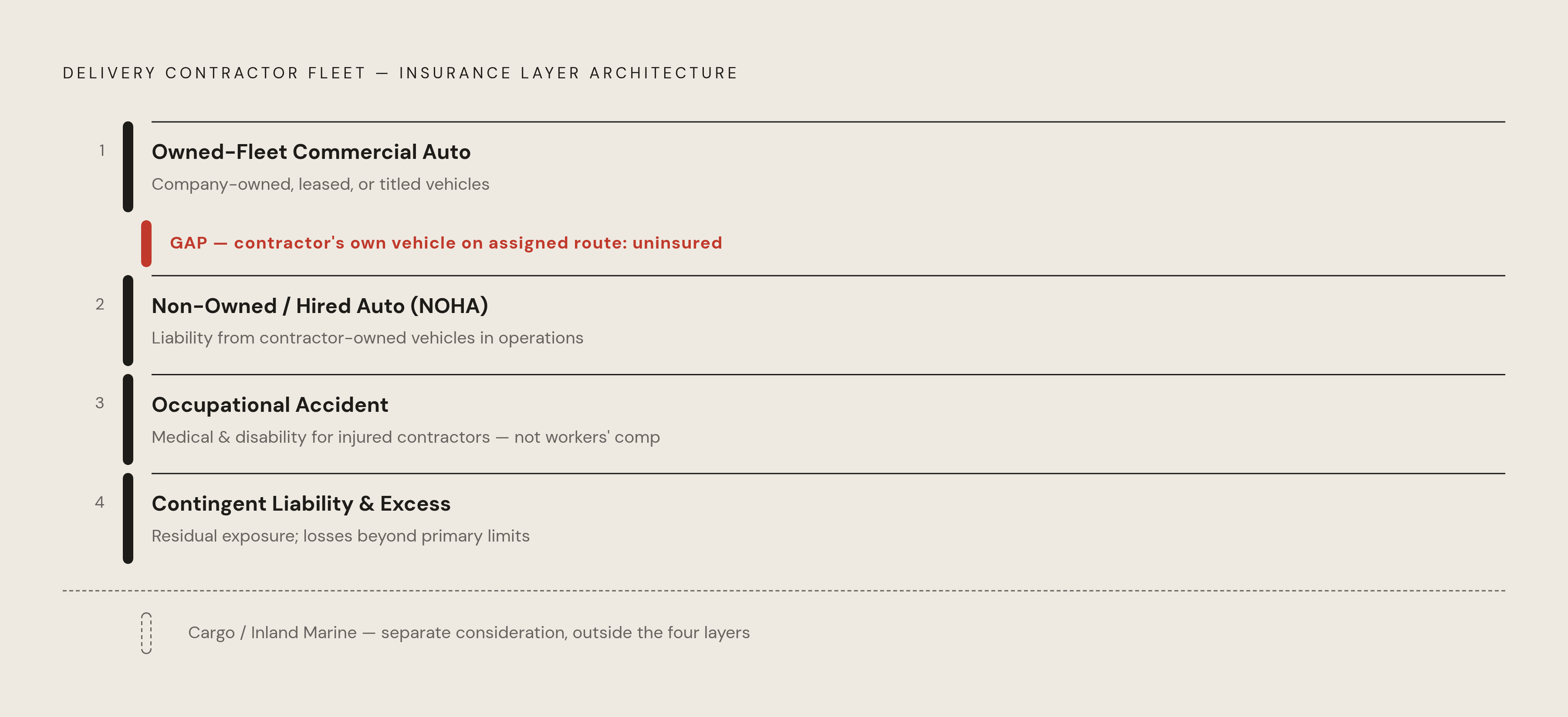
Commercial auto coverage for delivery contractor fleets is a layered architecture. Owned-fleet commercial auto, non-owned/hired auto, occupational accident, and contingent liability address different exposures. For large networks of independent contractors, bulk occupational accident insurance can lower costs through group purchasing, but getting group rates depends on having records of who is in the contractor pool. Protection and purchasing leverage start with knowing who is covered, for what, and when.
Why delivery contractor fleets face a structurally different insurance problem than standard commercial fleets
A contractor crashes while making a delivery in their own van. Their personal insurer denies the claim because the policy excludes business use. The operator has commercial auto insurance, but its policy covers only company-owned vehicles. The delivery was assigned. The unassigned liability is the structural problem with independent contractor fleets, where the vehicles, workers, and business directing the work belong to different legal entities.
A standard commercial fleet policy addresses a company’s vehicles and employees. The contractor model splits ownership from operation, so responsibility for insurance must be deliberately assigned across those parties. A contractor’s personal policy does not settle the question because personal auto policies contain business-use exclusions. Meeting the federal minimum that applies may still leave the operator short of what its contract requires. Freight brokers and project owners often ask for a seven-figure combined single limit even when the federal minimum is lower.
Delivery growth makes that separation increasingly consequential. The last-mile market is moving toward trillion-dollar scale within the next decade, while operators must get coverage for whole networks, which takes more than adding company vehicles to a schedule. More work can mean more independent insurance relationships. A fleet’s delivery capacity and its insured capacity are not automatically the same thing.
The four coverage layers and what each one is actually responsible for
Owned-fleet commercial auto liability is the first layer. It provides primary liability coverage for vehicles the operating company owns, leases, or titles in its name. Non-owned and hired auto, or NOHA, addresses the next exposure, namely liability arising from vehicles the company does not own but uses in its operations. Contractor-owned delivery vehicles belong in that discussion.
Occupational accident insurance is the third layer. It covers medical expenses and disability income for independent contractors injured on the job who are outside employer workers’ compensation because of their status. Contingent liability and excess protection cover the liability exposure that is left, including losses that use up the primary limits. Coverage for the vehicle’s liability does not pay the contractor’s injury benefits just because both losses came from the same accident.
Landstar System’s 10-Q illustrates the excess structure at scale. It describes a commercial auto liability arrangement above the primary layer, with a substantial aggregate deductible over a multi-year term originally ending April 30, 2026, subsequently amended to May 31, 2026. Cargo needs a separate place in the architecture. Inland marine or cargo insurance is not another liability layer, but commercial auto does not automatically cover the tools, equipment, or goods inside the vehicle.
How the non-owned/hired auto gap exposes operators who think their primary policy is enough
A contractor causes a loss while driving their own box truck on an assigned route. The operator submits the claim under its primary commercial auto policy, only to find that the policy applies to company-owned vehicles. The truck doing the work was never included. For last-mile networks whose contractors own or lease cargo vans, Sprinters, and box trucks, this is a routine operating arrangement.
NOHA extends the operator’s liability protection to non-owned vehicles used in the business. It must be explicitly added rather than assumed to be a standard inclusion in most commercial auto policies. The contract can expose the same gap. If a shipper requires a specified combined single limit and the operator’s policy covers only owned vehicles, contractor deliveries may put the operator in technical breach of that requirement.
Having contractors buy commercial auto insurance helps, but the operator still bears some of the risk. The operator still directs the work and can face contingent liability. A contractor’s inadequate limits or personal-use exclusion can leave that exposure uninsured.
Why occupational accident coverage is not optional for operators running 1099 fleets
An injured contractor creates a different insurance question from a damaged vehicle. Occupational accident insurance covers medical expenses and disability income for independent contractors who work in trucking, courier, and last-mile delivery jobs. This is protection for the operator as well. By providing benefits for the injured worker, it reduces the operator’s contingent exposure rather than leaving an uninsured injury to become a dispute about who should pay.
The financial comparison reinforces that role. Occupational accident coverage is a modest contractor add-on, a fraction of the commercial auto premium, while its absence can create exposure exceeding the primary auto loss. Treating it as a contractor perk misses that asymmetry. Its necessity is structural, even where it is not a universal legal requirement.
Platform benefits do not necessarily close the gap. Platform policies usually end when the delivery ends, so there may be gaps between deliveries, between apps, or outside active order status. California’s Proposition 22 provides app-based couriers with injury benefits through occupational accident rather than traditional workers’ compensation, but those benefits may not include permanent disability or supplemental job displacement.
China’s July 1, 2026 expansion of occupational injury insurance to all 31 provincial-level regions offers a directional signal. Platform companies pay premiums for each order to cover tens of millions of workers. The domestic risk turns on classification. If an injured contractor has no occupational accident coverage and their independent status fails under review, the operator can owe retroactive workers’ compensation.
How IC misclassification risk interacts with the coverage architecture
Independent contractor classification determines which injury coverage belongs in the stack. If a worker is reclassified as an employee after an injury, the operator may owe workers’ compensation benefits that an occupational accident policy was never designed to provide. The original separation no longer does its job. Buying the appropriate coverage for a contractor cannot cure the fact that the worker was legally an employee.
The Department of Labor issued Field Assistance Bulletin 2025-1 in May 2025, instructing investigators to stop applying the 2024 six-factor rule. On February 26, 2026, the department proposed rescinding that rule and restoring a modified version of the 2021 five-factor economic reality test, with control and opportunity for profit or loss as core factors. The comment period closed April 28, 2026, and the department is preparing a final rule. That federal shift does not override stricter state tests. California, Massachusetts, and New Jersey retain standards that multi-state operators must account for.
For those operators, the lesson is to maintain classification compliance at the strictest applicable state standard. Federal labor enforcement civil penalties can stack per worker for repeated or willful FLSA violations, before back wages and additional damages. Insurance brings another cost when the intended contractor coverage does not pay the injury benefits. Reporting relief does not change that result. (The One Big Beautiful Bill Act raised the 1099-NEC reporting threshold for calendar year 2026, indexed thereafter.)
What the underwriting market actually looks like for delivery contractor fleets in 2026
Coverage is available, but underwriting is becoming more selective. Clean loss histories, compliant contractor rosters, and documented safety programs help operators obtain competitive terms. Vehicle type alone does not describe the risk. An underwriter also needs evidence about the people operating those vehicles and the losses the network has produced.
Progressive’s Q1 2026 10-Q provides a useful market signal from the dominant carrier for this risk profile. Total applications in its core commercial auto products increased year over year, while new business applications decreased. New application growth declined across all business market targets except for-hire specialty and tow, including business auto, contractor, and for-hire transportation. The filing attributes the pattern to rate and non-rate actions addressing profitability challenges.
For operators, the consequence is a greater burden of documentation. A network without a documented loss history or current contractor records has less evidence with which to support its underwriting case. The same records that establish operational control over risk also support the request for favorable terms.
How can delivery companies reduce insurance costs through bulk purchasing?
Bulk occupational accident insurance lets delivery companies seek group rates for their network of contractors instead of having each driver buy coverage on their own. For an operator seeking group accident coverage for a large network of drivers, the relevant purchasing asset is a credentialed pool. Underwriters need evidence of who belongs in that pool, including verified driver records, current insurance certificates, and completed safety training.
Commercial auto can follow the same group-pricing logic when the fleet is large enough. Fleet-rated policies use aggregate loss experience instead of the history of each vehicle, so strong safety programs and records of driver screening can earn better rates. The distinction is how the risk is presented. When contractors buy on their own, each is assessed separately. When they buy as a group, the network’s risk can be assessed as a whole.
ISNetworld and Avetta centralize safety certifications, insurance records, and pre-qualification decisions for contractor networks. That infrastructure supports purchasing because it makes the roster legible to underwriters. Operators with credentialed, monitored pools can access better rates than those unable to document their contractors. Group purchasing therefore changes the economics of the coverage stack without removing the need for any of its layers.
Why real-time contractor monitoring is an insurance management tool, not just a compliance program
A roster that helps an operator get group pricing at the start can change before renewal. A commercial auto certificate expires, a CDL lapses, or an event on a motor vehicle record sets off an exclusion. The paperwork may still look perfectly respectable. Meanwhile, the actual risk no longer matches the information on which the coverage was arranged.
Each layer depends on a different part of that current record. NOHA assumes that contractors work within the law and keep the required minimum insurance, while qualifying for occupational accident depends on their independent contractor status. Primary commercial auto depends on having the right information about vehicles and drivers. Annual certificate collection and renewal-time motor vehicle record checks leave intervals in which those conditions can change without appearing in the operator’s files.
A DUI, reckless driving conviction, or license suspension between reviews is an underwriting event. It can affect the contractor’s insurability and the fleet’s aggregate risk rating at renewal. Centralizing credentials helps, but storage alone is not monitoring. Managing insurance means catching changes between qualification checks, when a record that was once valid may show only the coverage a contractor had yesterday.
Building the coverage stack operationally through onboarding, credentialing, and contractor data
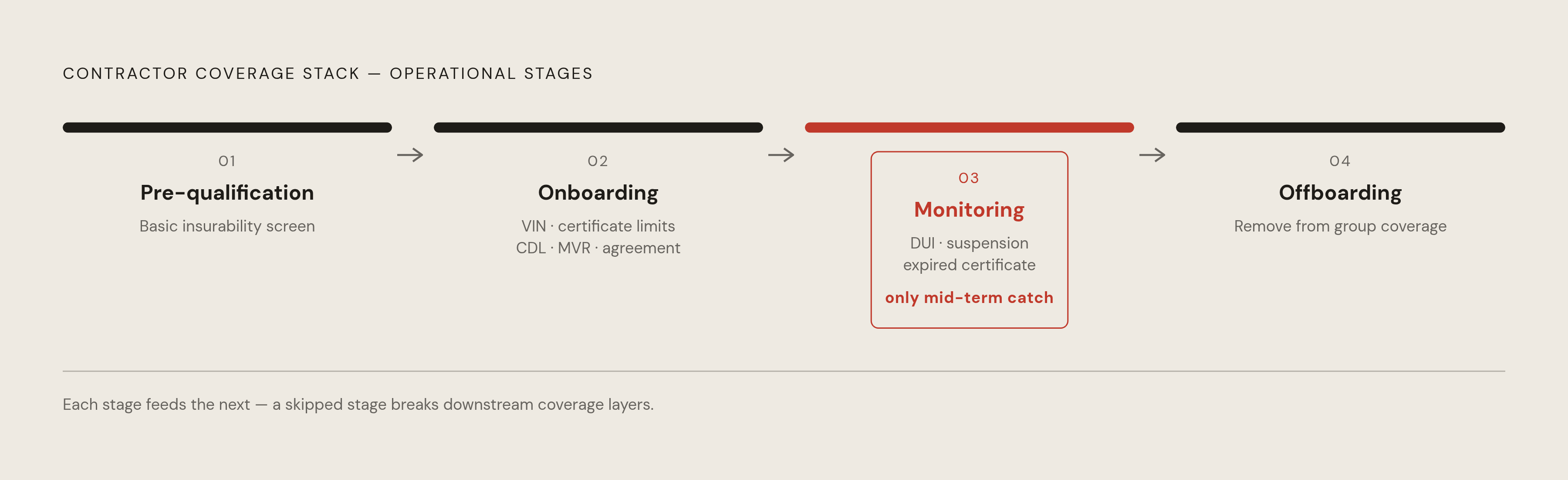
Onboarding gathers the information that each coverage layer needs to work. Vehicle details support NOHA, independent contractor documentation supports occupational accident eligibility, driver records support primary commercial auto, and cargo details support inland marine coverage. Missing data creates uncertainty from the start. Vehicle VINs, personal auto certificate limits, CDL status, motor vehicle record history, and contractor agreement terms therefore belong in the same operational process.
The recommended process has four stages, namely pre-qualification, onboarding, monitoring, and offboarding. Pre-qualification screens for basic insurability, while onboarding captures policy details. Monitoring detects changes that can affect coverage. Offboarding removes the contractor from group coverage. Each stage creates records the next depends on, making the stack a maintained system.
That process can also reduce friction for contractors. Checking identity, banking details, and contractor status helps with both compliance documentation and faster payment through push-to-card or same-day ACH. Pay speed is a retention variable in contractor networks, so integrating compliance and payments gives the same data more than one useful job. A workforce management platform built for IC networks can bring together onboarding, credential tracking, monitoring, and payments without manual back-office work growing at the same rate as the fleet.
The resulting record gives the operator something concrete to present at renewal, in group-rate negotiations, and when a shipper requests proof of insurance. It can document loss history, identify the covered pool, and support contractual certificate requirements on demand. That is where coverage architecture becomes a commercial advantage.