Jurisdictional Classification Variance and the Case for a Unified Multi-State Compliance Stack
Unified compliance software can expose misclassification risks before dispatch.
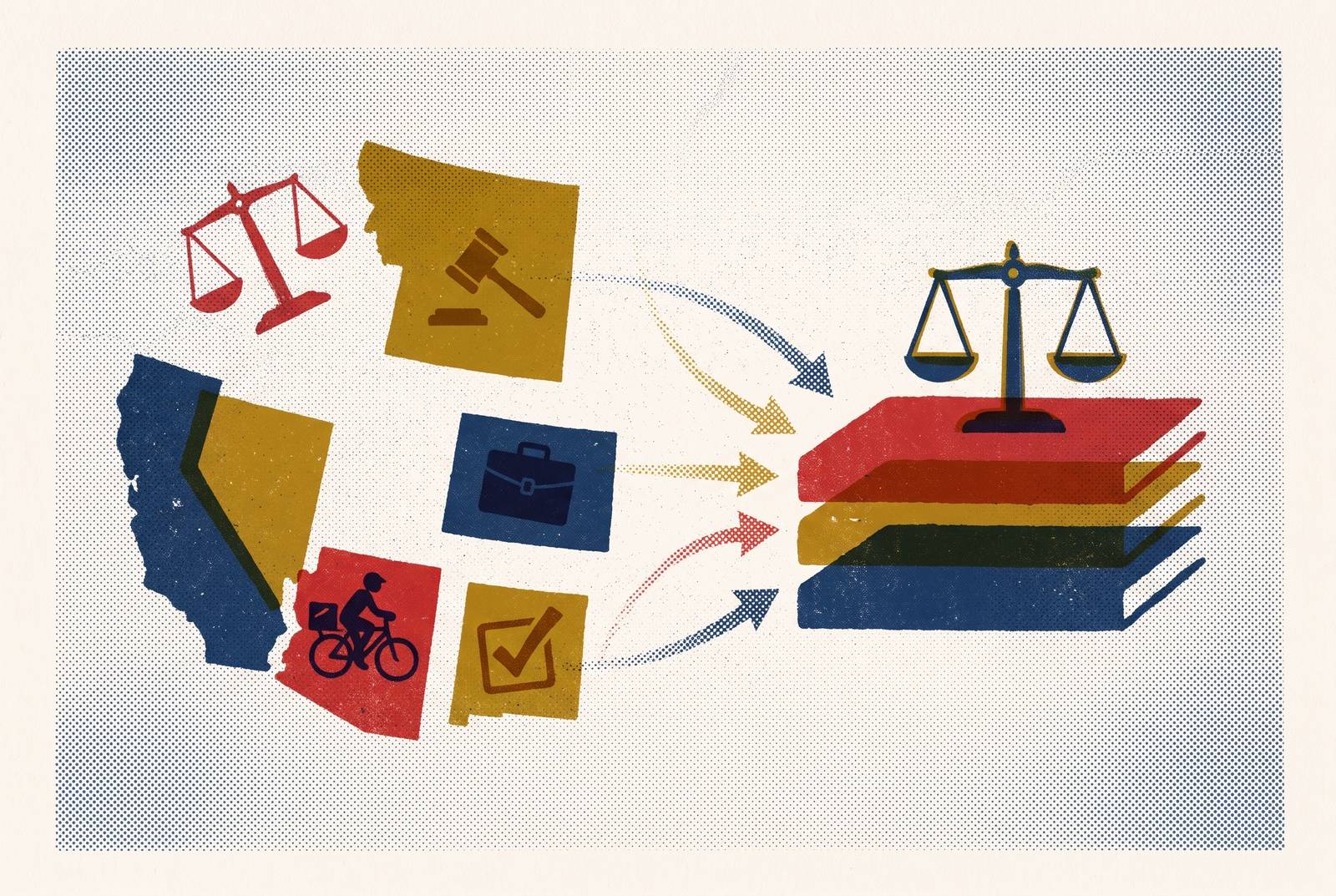
For delivery companies managing worker classification laws and independent contractor rules across states, the right compliance software must apply each jurisdiction’s tests, monitor actual working practices, and connect credentials, insurance, and payments. A unified multi-state compliance stack can do this while keeping the classification rules of each state intact. It can expose an ineligible contractor relationship before dispatch, though it cannot make that relationship lawful.
Why the same contractor can be two things at once — the structural reality of multi-state classification
A courier crosses a state line mid-route. The vehicle, assignment, and working relationship stay the same, but the applicable classification standard can change. The same worker can qualify as an independent contractor under one state’s test and as an employee under another’s. The applicable classification standard depends on where the contractor performs the work, regardless of where the delivery company keeps its headquarters.
Three test families create this overlap. The Department of Labor’s economic-realities test is used for federal wage-and-hour obligations, while the IRS common-law right-to-control test is used for federal employment tax. States apply ABC, modified ABC, or common-law tests for obligations including wages, unemployment insurance, and workers’ compensation. A worker can pass the IRS test and fail California’s ABC test on the same engagement.
For delivery operators, the sharpest obstacle is Prong B of a standard ABC test, which requires work to be “outside the usual course of the hiring entity’s business.” Contractors delivering for a delivery company perform its core function. Schedule flexibility cannot change what the company sells. Nor can evidence that a courier serves multiple clients rescue a relationship that fails this requirement.
How many states apply which test, and why the map keeps changing
A majority of states apply some form of ABC testing, but that description conceals substantial differences. Modified ABC states using Prongs A and C only are Colorado, Idaho, Montana, Pennsylvania, Wisconsin, and Wyoming. Removing Prong B changes the exposure for delivery operators because it removes the outside-usual-course requirement. This drafting difference changes which facts can support independent contractor status.
Common-law or hybrid states are Alabama, Arizona, Florida, Iowa, Kentucky, Michigan, Mississippi, Missouri, New York, North Carolina, North Dakota, South Carolina, South Dakota, Texas. Yet a more permissive wage-law test does not necessarily mean a more permissive unemployment insurance test. Some states in this group apply stricter unemployment standards. A single label on a state map therefore provides an incomplete answer. The same jurisdiction may require separate analysis for separate obligations.
Legislative change adds another dimension to that geography. New Jersey’s final ABC regulations went into effect on October 1, 2026. California’s AB 1340, which took effect on January 1, 2026, gave both rideshare and delivery drivers collective bargaining rights under the same framework. Platforms that run both fleets now have another set of legal rules to follow within a single state.
What the federal flux adds — and what it cannot resolve
Even a finalized federal rule cannot override stricter state ABC tests, so operators in California, Massachusetts, or New Jersey retain their Prong B exposure regardless of Washington’s approach. Changes at the federal level give operators one more shifting standard to track alongside the different state rules. Waiting for a federal answer leaves operators exposed to state obligations that remain in force.
The Department of Labor’s Field Assistance Bulletin 2025-1, issued May 1, 2025, stopped investigators from applying the 2024 six-factor rule. That rule nevertheless remains in effect for private FLSA litigation. Investigators use 2008 guidance in Fact Sheet #13, further informed by Opinion Letter FLSA2019-6, while courts apply economic-reality analysis from case law and are not bound by either administrative approach. The department then proposed a narrower test on February 26, 2026, prioritizing control and opportunity for profit or loss. Enforcement and litigation are not moving in lockstep.
For operators, the practical response is to classify against the strictest applicable test in each state where work occurs. The 1099-NEC filing threshold rises substantially from $600 for 2026 payments, with filings due February 1, 2027. A different filing threshold is not permission to treat an employee as a contractor.
What misclassification actually costs a delivery operator — beyond the fine
Reclassification can activate several liabilities at once. Back contributions to state unemployment insurance, paid family and medical leave, and sick-leave programs can attach together with retroactive wage-and-hour claims. In California, the Labor Commissioner, PAGA representative actions, and private plaintiffs can all create exposure. The resulting state-level reassessment can exceed the federal one.
Operational disruption belongs in a different risk category. New Jersey continues to issue stop-work orders under its 2020 misclassification legislation, Assembly Bill A5838. A fine can be budgeted for, however reluctantly. An order that stops work reaches directly into the company’s ability to deliver.
Delivery contractors typically have occupational accident coverage while making deliveries, but that coverage has gaps between deliveries, between apps, or off the clock. Those gaps leave contractors vulnerable and can create operator liability if reclassification applies workers’ compensation standards retroactively. Neither a signed agreement nor an active-delivery policy answers what happens across the full working relationship.
Why managing classification jurisdiction by jurisdiction at scale breaks down
Separate state-by-state administration looks reasonable until its moving parts interact. In 2026, New Jersey’s final ABC regulations, California’s AB 1340, and Kansas HB 2602 each required a different response. One sets rules for classification, another for collective bargaining, and another for portable benefit contributions. They cannot be handled as interchangeable updates. The compliance process must turn each change in the rules into a change in how the operator handles the work.
Applying the strictest state’s test everywhere can impose unnecessary treatment and obligations in common-law states while still overlooking differences between wage and unemployment tests. Uniform treatment is not the same as complete analysis. The useful form of unification is one system that preserves jurisdictional distinctions.
Licenses, insurance certificates, and background checks expire on individual schedules that do not align with regulatory effective dates or quarterly audits. Small state footprints do not remove this exposure, and a stop-work order can make a supposedly economical manual process expensive very quickly. An October 1 rule change cannot wait for a review after a November enforcement action.
What software helps delivery companies manage compliance across the contractor lifecycle
A unified stack earns its value by applying rules. At onboarding, it must identify every state where a contractor will work and apply the relevant classification tests for each. Prong B vulnerabilities need to surface before the first dispatch. A searchable folder cannot do that job alone. The system must distinguish a relationship requiring review from one whose paperwork is simply incomplete.
During active deployment, automated expiration tracking, advance notification, and dispatch lockout for non-compliant contractors address the gap between onboarding and continued eligibility. Continuous monitoring must also account for regulatory changes as they take effect. These are distinct monitoring tasks with a shared purpose. One follows the contractor’s records. The other follows the rules those records must satisfy. Both need to inform whether work can proceed.
Insurance integration should make occupational accident and commercial auto coverage visible and current, with gaps flagged automatically. Visibility keeps coverage status from remaining hidden in a separate vendor relationship until an incident exposes it, while leaving the policy’s coverage unchanged. Contractors also need access to their own compliance status, expiration dates, coverage, and pay. A system that informs only the operator leaves the person expected to stay compliant working with less information.
The system needs to support fast payment because compliant contractors who are paid slowly may leave for platforms that pay faster. Same-day ACH and instant debit reduce that retention pressure, limiting the need to expand the pool and repeat onboarding. Actual working practices need attention as well. Monitoring dispatch patterns, exclusivity, and schedule assignment can supplement an agreement with evidence for classification tests that weigh those facts, while a relationship that fails Prong B remains ineligible under that requirement.
How portable benefits legislation could reshape classification stakes — and why it does not change the near-term calculus
Portable benefits can make things better for contractors while leaving their classification unsettled. Kansas HB 2602, passed in 2026, allows contributions to contractors’ health, retirement, or other portable accounts without using those contributions to determine employment classification. Utah enacted a portable benefits law in 2023, while Florida is evaluating programs for gig and freelance workers. Evaluation is not enactment, and the geographic differences remain.
These laws govern how benefits are provided while leaving other classification requirements in place. A health account cannot change whether delivery is a delivery company’s usual business. Nor has a federal portable benefits framework advanced to the point of preempting state tests. Broader adoption could reduce part of the stakes while leaving operators with multiple applicable standards. Delaying compliance infrastructure would therefore depend on a resolution whose timeline is not visible in current legislative progress.
What operators should do now to move from jurisdictional patchwork to unified compliance
Operators should map every state where contractors actually work, then check wage-law and unemployment tests on their own terms in each state. Headquarters location is not a substitute for that map. Existing relationships in ABC states should then be reviewed against Prong B first, particularly where contractors perform the company’s core delivery function. This establishes which problems technology can help administer and which require a different classification treatment.
The next step is to replace annual or quarterly reviews with continuous credential and compliance monitoring. Automated expiration tracking and lockout-on-expiration connect a document problem to an operational response before more work is assigned. Occupational accident and commercial auto coverage need to be visible, current, and tied to active deployment status, with gaps addressed. Integration is useful only if it changes what happens when coverage is insufficient.
Pay speed and evidence of independence complete the operational change. Operators should use instant debit and same-day ACH to help keep contractors and cut the risks that come with turnover and repeated onboarding. They should also maintain an ongoing record of actual practices, including contractors’ schedules, work for multiple clients, and provision of their own equipment. The contract is only the starting document. Those facts need to remain available for the tests that weigh them, without being mistaken for an answer to every test.
Operators that build this infrastructure can onboard faster, assess expansion into new states with greater confidence, and absorb regulatory changes without waiting for the next audit cycle. Each new market still has its own rules to meet. A unified stack makes those differences manageable within the operating system of the business, turning compliance from a constraint on multi-state delivery growth into a competitive advantage.