Arbitration Clause Enforceability in Independent Contractor Agreements
Supreme Court ruling narrows arbitration shields for delivery operators nationwide.

Delivery operators and gig platforms built their entire legal defense around one document: the mandatory arbitration clause buried in every IC agreement. That clause blocked class actions over misclassification, wage-and-hour violations, and benefits disputes, which happen to be the exact claims that produce the largest exposure in any contractor-heavy business. For over a decade, operators treated the clause as standard paperwork, never questioning whether it was a legal position that might not hold. That assumption is now a liability. The Supreme Court's May 28, 2026 decision in Flowers Foods, Inc. v. Brock is the clearest signal yet that the shield operators built their businesses on has a widening crack in it.
Why arbitration clauses became the default risk shield
The Federal Arbitration Act gave operators something close to a guarantee. Under Section 2, a written arbitration agreement is valid and irrevocable unless a recognized contract defense applies, and federal policy resolves doubts in favor of arbitration, not litigation. Courts spent the following years reinforcing that guarantee. AT&T Mobility LLC v. Concepcion in 2011 upheld class action waivers in the consumer context, and Epic Systems Corp. v. Lewis in 2018 did the same in the employment context, preempting state rules that tried to condition enforcement on class-wide procedures. So those two rulings gave operators strong legal footing to pair an arbitration clause with a class action waiver, and that closed off the courtroom entirely for workers with wage and classification disputes.
The combination became standard practice across the economy. More than 60 million workers are now covered by employment arbitration programs, and most large employers pair the requirement with a class action waiver as a matter of course. For years, that pairing looked close to bulletproof.
The ground has moved. A line of Supreme Court decisions, New Prime in 2019, Saxon in 2022, Bissonnette in 2024, and now Flowers Foods in 2026, has progressively widened the FAA's Section 1 transportation worker exemption, with each ruling reaching further than the one before it. At the same time, state legislatures and enforcement agencies have gotten more aggressive. Flowers Foods is the most recent and most consequential entry in that pattern, and it's the reason 2026 is the year operators need to stop treating their arbitration clauses as settled law.
How the FAA's Section 1 transportation worker exemption works
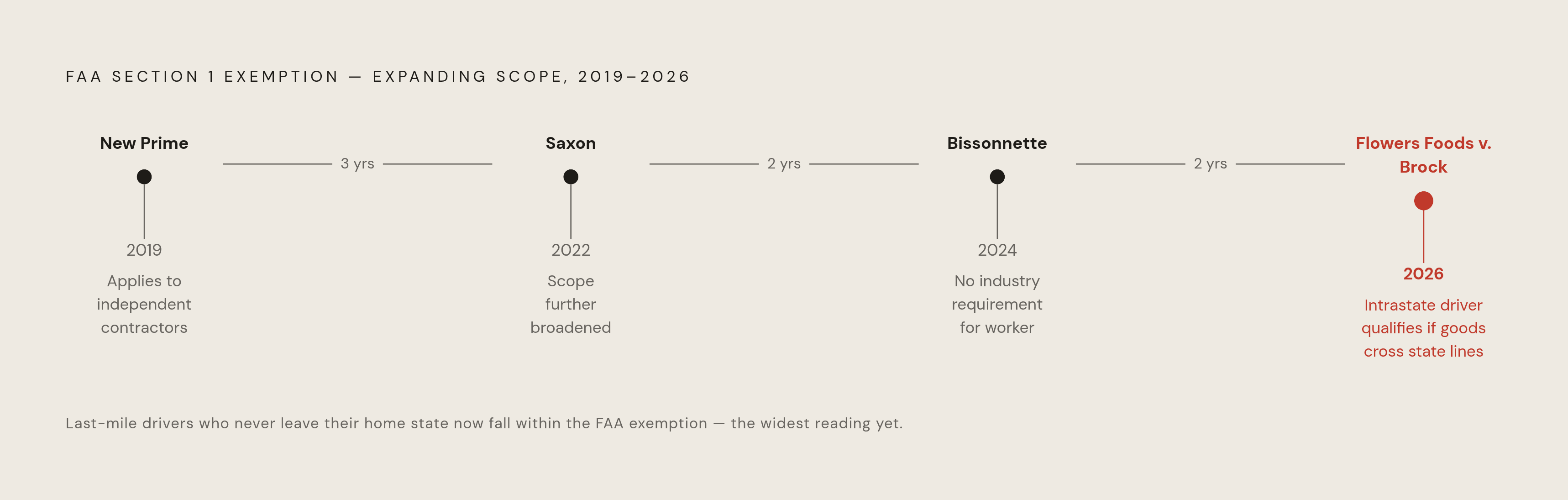
Section 1 of the FAA is the single most important provision for any IC operator to understand, because a worker who falls within it cannot be compelled to arbitrate under the FAA at all, even where a signed, valid arbitration agreement exists. The exemption covers "contracts of employment" of seamen, railroad employees, and "any other class of workers engaged in foreign or interstate commerce." The Supreme Court has read that language expansively rather than narrowly, and each recent case has pushed the boundary further out.
New Prime, decided in 2019, extended the exemption to independent contractors, not just employees, establishing that the IC label on a worker's contract does nothing by itself to remove that worker from Section 1's reach. Bissonnette, in 2024, dropped a requirement that had quietly limited the exemption's reach for years: the worker no longer needs to be employed in the transportation industry itself to qualify.
Flowers Foods, Inc. v. Brock, decided unanimously on May 28, 2026, closes the loop. The Court held that a last-mile delivery driver qualifies for the Section 1 exemption even without ever crossing a state line. What matters is whether the worker transported goods on an intrastate segment of a continuous interstate journey, playing a direct and necessary role in that journey, regardless of whether the worker's own route is interstate. A driver who never leaves Colorado can still be exempt from FAA arbitration if the package in the truck started its journey somewhere else.
The ruling has a limit operators will lean on: the Court did not create a bright-line rule that sweeps every local driver into the exemption. Workers performing purely local work, with no connection to an interstate supply chain, remain outside Section 1. And Flowers Foods addresses FAA coverage only. It doesn't void the arbitration agreement by itself; it means the FAA's enforcement mandate no longer applies to that worker, and enforcement, if it's sought at all, has to happen under state arbitration law instead.
IC operators and delivery workers most exposed after Flowers Foods
The "direct and necessary role" standard from Flowers Foods puts a wide range of delivery and logistics operators in a materially different legal position than they occupied before May 2026. Package and parcel delivery services whose drivers handle goods originating out of state sit squarely inside the new exposure. Third-party logistics providers whose contractor networks handle the final leg of interstate shipments, and retail delivery networks tied to national merchants, round out the list of operators who should assume Flowers Foods changed their legal footing.
A 2025 decision from the Second Circuit adds a complication that many operators will not have anticipated. The court held that a distribution agreement between a bakery distributor and two single-employee corporations still qualified as a "contract of employment" under New Prime. The court looked past the paperwork. If operators adopted single-person-entity structures just to put daylight between their contractor relationships and the transportation worker exemption, they should not assume that structure still holds after this ruling. Workers who genuinely sit outside the exemption, doing purely local work with no tie to an interstate supply chain, do not automatically fall into Section 1. But the operator carries the practical burden of proving that distinction if a worker or a regulator challenges it, and "we assumed" is not evidence.
State arbitration law as the fallback when the FAA no longer applies, and its limits
Once the FAA is displaced by the Section 1 exemption, state arbitration law takes over, and state law is nowhere close to uniform. The same clause that holds up cleanly in one state can be voided outright in another, which turns a single national IC agreement template into a patchwork of enforceability risk the moment Flowers Foods pulls FAA coverage away.
New York is the clearest example of where that patchwork is heading. Senate Bill S3868, introduced in the 2025-2026 session, now sits in the Senate Judiciary Committee, and it proposes to prohibit mandatory pre-dispute arbitration clauses and joint-action waivers in any contract of employment. The bill has not passed. Operators in New York, or operators with New York-based contractor populations, should be watching this bill's progress.
Federal contractors carry an additional, narrower layer of restriction. A DFARS clause prohibits mandatory arbitration of Title VII claims and sexual assault or harassment torts for contractors and covered subcontractors. That provision doesn't touch most IC operators, but any operator with federal contracting relationships needs to know those categories of claims cannot be forced into arbitration against ICs, regardless of what the clause itself says.
State-law enforcement comes with its own defenses built in. The FAA's savings clause preserves generally applicable contract defenses: unconscionability, fraud, lack of consent. So the practical result cuts against operators who built their clauses assuming FAA preemption would always be there to override a hostile state law. Once that preemption is gone for a given worker, the clause is exposed to exactly the state-level attacks the FAA used to block.
The drafting defects that void arbitration clauses regardless of FAA coverage
A clause can pass the FAA exemption analysis cleanly and still fail for reasons that have nothing to do with Section 1. Recent appellate decisions show courts are willing to find defects in formation or fairness even in clauses operators assumed were airtight.
The most common and most avoidable failure is unilateral amendment. The First Circuit ruled in 2025 that an arbitration agreement is unenforceable where the contract lets one party amend the arbitration terms "at any time" without notifying the other side. It's a common drafting shortcut, inserted so operators can update terms without renegotiating every IC agreement in the fleet, and it is now a documented way to lose the clause.
A related failure involves who can even invoke the clause. The First Circuit held in Morales-Posada v. Cultural Care, Inc. in 2025 that a nonsignatory to a contract cannot enforce its arbitration clause. Equitable estoppel and third-party beneficiary arguments both failed in that case. The party trying to compel arbitration needed to show an actual assignment of rights or be named as an unambiguous beneficiary of the clause itself, and generic affiliation with the contracting party wasn't enough.
Unconscionability remains a live defense regardless of FAA coverage. A clause buried in fine print, one that imposes prohibitive costs on the contractor, or one that reserves all meaningful remedies for the drafter can fail on these grounds alone, and the FAA's savings clause preserves this defense even where the FAA otherwise applies. Courts also continue to ask two threshold questions before enforcing any clause: did the parties actually form an agreement to arbitrate, and does the dispute in front of them fall within that agreement's scope. Most modern clauses delegate arbitrability questions to the arbitrator, but challenges to the formation or basic fairness of the agreement itself stay with the courts. So drafting discipline isn't optional, even if operators feel confident their workforce sits outside Section 1.
The limits that regulators and class exposure place on arbitration clauses
A fully enforceable, perfectly drafted arbitration clause does not stop a regulator from knocking on the door. Treating the clause as a substitute for compliance infrastructure, rather than one piece of it, is a mistake with a track record of getting expensive.
Arbitration agreements with class action waivers bind the contractor who signed them. They do not bind the government. Federal and state regulatory agencies can conduct audits and bring enforcement proceedings entirely unaffected by any private arbitration agreement sitting in a file somewhere. The Illinois Attorney General's July 2026 settlement with an online staffing platform makes the point concretely: the settlement, reached over IC misclassification under the Illinois Minimum Wage law and the Day and Temporary Labor Services Act, required the company to reclassify workers as employees and let those workers recover unpaid wages, penalties, and interest. The Minnesota Attorney General's 2025 settlement with Shipt over delivery worker misclassification followed the same pattern, addressing the underlying classification conduct directly.
Arbitration itself has structural limits that compound the problem. Awards are private, final, and non-precedential. If a practice is actually illegal, it keeps running until a court says so, because an arbitrator's ruling doesn't travel.
The regulatory environment is adding pressure. The DOL issued Field Assistance Bulletin 2025-1 in May 2025, directing investigators to stop applying the 2024 independent contractor classification rule, and followed that on February 26, 2026 with a proposed regulation that tends to favor IC status. Plaintiffs' attorneys are reading it as an opportunity, because operators who lean too hard on a favorable federal posture become the next class action target, not the next compliance success story.
Requirements for a legally durable IC arbitration clause in 2026
You keep an arbitration clause standing after Flowers Foods and the 2025-2026 drafting cases by working two tracks at once. The clause itself has to be structurally sound, and the contractor relationship it rests on has to be compliant enough that the clause is never the last line of defense standing between an operator and a class action.
On the clause itself, you should start by assessing whether your contractor population falls within the Section 1 exemption under the direct-and-necessary-role standard Flowers Foods established; if drivers handle goods moving through an interstate stream, you should assume exposure and build state-law enforcement into the plan as a backstop. Any unilateral amendment provision allowing changes "at any time" without notice needs to come out of the agreement, since the First Circuit's 2025 ruling makes that provision illusory under at least Massachusetts and New York law. If you work in New York, or in any state with active arbitration-restriction legislation, you should track Senate Bill S3868 specifically, because retroactive nullification of existing IC arbitration clauses is written into its scope if it passes. And if you work as a federal contractor, you need clauses that exclude Title VII claims and sexual assault or harassment torts for covered subcontractor arrangements, because the relevant DFARS provision prohibits mandatory arbitration of those claims.
None of that matters much if the underlying contractor relationship is a mess. Real-time compliance monitoring, rather than periodic audits that catch problems months after they start, is what lets an operator spot classification drift, lapsed credentials, or insurance gaps before a regulator or a plaintiff's attorney turns them into the factual basis for a case. Onboarding is the first compliance event that matters: W-9 collection, credential verification, and insurance confirmation at the start of the relationship build the paper record that supports IC status later, instead of leaving an operator scrambling to reconstruct that record after a claim has already landed. Insurance coverage for the contractor workforce, occupational accident coverage and commercial auto in particular, reduces the injury claims that surface most often when drivers are misclassified and locked out of workers' compensation, and carrying that coverage in bulk also signals an operator's actual investment in contractor protection, which matters to a classification analysis down the line. Fast, transparent payment works the same way on the wage-and-hour side: delayed pay and opaque deductions are the factual basis for the claims operators hoped their arbitration clauses would contain.
When the two tracks are put together, the arbitration clause functions as a dispute resolution mechanism again, not as the only wall between an operator and a class action with its back against the door.