Federal Circuit Split on Economic Reality Test Factors
Courts are splitting on which factors matter most in classifying workers as employees.

The phrase "economic reality test" sounds like a single yardstick, the kind of thing you'd find bolted to a wall at the Department of Labor with a laminated instruction sheet. It is closer to a family name shared by several unrelated cousins who all show up to the reunion with different opinions about how to carve the turkey. The DOL itself has swapped the recipe twice in five years: it moved from a six-factor totality-of-circumstances framework under the 2024 Biden rule to a two-core-factor hierarchical test that echoes the 2021 approach, and it's mid-rulemaking again right now. Courts follow their own tests, independent of the DOL's recipe. Loper Bright Enterprises v. Delivery and last-mile operators running 1099 contractor networks sit closest to this instability, because their entire business model depends on a classification call holding up in every jurisdiction at once, not just the one where headquarters happens to be. Anyone running a multi-circuit contractor network is operating under several tests at once, whether anyone told them that at kickoff or not.
The DOL's Proposed Two-Factor Framework
On February 26, 2026, the DOL's Wage and Hour Division proposed a rule that would scrap the 2024 rule's six-factor, no-factor-dominates approach and replace it with a two-core-factor test built around a clear hierarchy. The first core factor is the nature and degree of control over how the work gets done. The second is the worker's opportunity for profit or loss based on initiative or investment, not simply working longer hours or moving faster. On control, the proposed rule states that requiring contractors to follow health and safety rules, or to carry insurance, does not amount to the kind of control that turns a contractor into an employee, a detail that matters directly to any operator who makes insurance coverage a condition of engagement. On profit and loss, the test asks if a worker can move the needle on earnings through business judgment or capital investment, not just elbow grease.
Three secondary factors survive the rewrite: skill required, permanence of the relationship, and whether the work sits inside an integrated unit of production. But they are demoted, not retained on equal footing. When the two core factors point the same direction, the proposed rule says the secondary factors are "very unlikely," alone or together, to flip the outcome. The rule also insists that actual practice controls, not what a contract theoretically permits, a detail that becomes the hinge of nearly every dispute where the written IC agreement and the daily reality of the job disagree with each other.
As of the sources behind this rulemaking, the comment period closed April 28, 2026, and a final rule is expected late summer or fall 2026. Until that happens, the 2024 Biden rule stays on the books at 29 CFR Part 795, even though the DOL told its own investigators to stop enforcing it, via Field Assistance Bulletin 2025-1 in May 2025. The proposed rule would also stretch the same two-factor analysis to cover the Family and Medical Leave Act and the Migrant and Seasonal Agricultural Worker Protection Act, a wider reach than the 2024 rule ever attempted. So one rule stays live while nobody enforces it, and the proposed rule can't yet be cited as binding. That gap is the whole problem.
DOL Enforcement Guidance Does Not Protect Against Private Litigation
Field Assistance Bulletin 2025-1 tells DOL investigators how to do their jobs. It has nothing to say to a federal judge. A company that structures its contractor relationships to satisfy the proposed two-factor test in good faith can still get sued privately under the Fair Labor Standards Act and find the case decided under the older six-factor framework the courts never agreed to retire. The 2024 rule hasn't been vacated anywhere; it sits codified at 29 CFR Part 795, available for any plaintiff's attorney to cite, regardless of whether the DOL itself has lost interest in enforcing it.
Loper Bright removed the assumption that courts bow to agency interpretations, so federal judges now run their own economic-reality analysis, and circuits don't all run the same one. The practical result: a delivery company that clears both core factors under the proposed rule can still lose a private misclassification suit in a circuit that leans harder on permanence, integration, or investment than the DOL's new framework does. DOL enforcement and private litigation are two separate channels of exposure, and the large settlements in this space have never come from DOL enforcement actions. They come from private class and collective actions, filed by plaintiffs who don't care what Field Assistance Bulletin 2025-1 says about how investigators should do their jobs.
The Eleventh Circuit's Galarza decision as a case study of circuit divergence
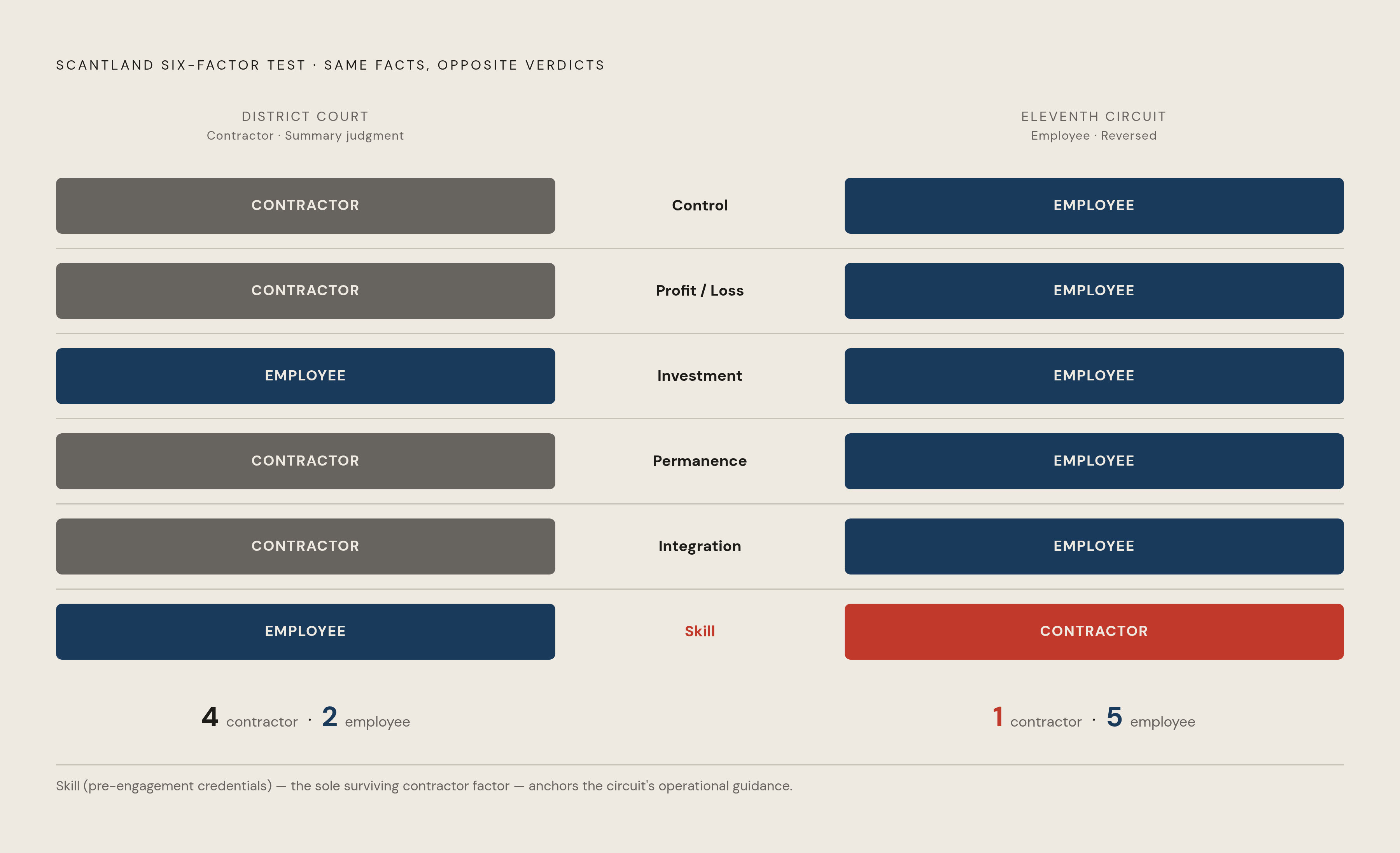
Galarza v. One Call Claims, LLC, decided by the Eleventh Circuit on October 16, 2025, is the clearest demonstration available of how two courts can run the same named test on the same facts and land in opposite places. Three licensed insurance adjusters, assigned by One Call Claims to the Texas Windstorm Insurance Association in the aftermath of Hurricane Harvey, sued for unpaid overtime, claiming they'd been misclassified as independent contractors. The district court, applying the Eleventh Circuit's own six-factor Scantland framework in 2023, found four factors favoring contractor status and two favoring employee status, and granted summary judgment for the defendants.
The Eleventh Circuit reversed, using the identical Scantland framework, and found five factors favoring employee status with only one favoring independent contractor status.
On control, the Texas Windstorm Insurance Association set the adjusters' schedules, reviewed their timesheets, tracked performance through software that measured typing speed and words typed, and restricted Sunday work. The appellate panel found a jury could reasonably conclude these were not workers operating as a "separate economic entity." On profit or loss, the adjusters were paid fixed, non-negotiable daily wages. The defendants argued the workers controlled their own costs, transportation, meals, lodging, but the court waved this off, noting that "many of them are little more than personal expenses" unconnected to any managerial skill or added earning opportunity. On investment, the defendants supplied most of the equipment and materials; the adjusters' license fees and travel costs weren't enough to tip the scale. On permanence, the contracts described "separate and standalone assignments of indefinite duration," but in practice the assignments ran one and a half to two years, during which the workers generally didn't service other companies, with one narrow exception where an adjuster briefly worked for different insurers. The court looked at the real duration, not the contract language, and found it supported employee status. On integration, the adjusters were central to both companies' business models, another factor for employee status.
The one factor that held for independent contractor status was skill, because the adjusters had earned their training and licenses before the assignment ever started. It means pre-engagement credentialing is not just good onboarding hygiene, it is the one line item a federal appellate court actually credited toward contractor status in this case. The Eleventh Circuit didn't care what the contract said the parties could have done. It cared what they actually did.
How other circuits weight the same factors differently
Galarza isn't a lonely data point. The Fourth Circuit, on July 17, 2025, upheld a $9.3 million judgment against a medical staffing company for misclassifying travel nurses, with five of six economic reality factors weighing toward employee status. Two different circuits, in the same year, running six-factor frameworks, landing on the same side of the ledger against the defense.
The pattern matters, but the factor weights and the order in which courts work through them aren't identical. The same facts could play out differently elsewhere. Take control. Some circuits ask simply whether control over the manner of work exists; others ask whether that control is significant enough to signal economic dependence, and the threshold for "significant" moves depending on the bench. Take permanence. Some courts treat a fixed-term contract as proof of contractor status by design, but the Eleventh Circuit in Galarza looked past the contract's language and asked how long the relationship actually ran. Take integration: some circuits ask whether the work is operationally central to the business, others ask whether it could be pulled out of the production process without disrupting it, and those are not the same question. Take investment: Galarza drew a hard line between personal expenses, which don't count, and capital investment in an independent business, which does, and that line isn't drawn the same way everywhere.
None of this means every circuit is a law unto itself. It means an arrangement that clears the dominant test in one circuit isn't guaranteed to clear the dominant test in the next one over, and a multi-circuit delivery network built on a single classification template is building on sand of inconsistent density.
Where state law creates an additional and stricter layer
Federal law is the floor, not the ceiling, and several of the country's highest-volume delivery markets have built a much taller ceiling. California, Massachusetts, and New Jersey all apply the ABC test, which requires all three prongs to be satisfied before a worker can be classified as a contractor, a structurally tougher bar than any version of the federal economic reality test currently on offer. New Jersey raised that bar further: the New Jersey Department of Labor and Workforce Development finalized ABC test regulations on independent contractor status, effective October 1, 2026, putting the state among the strictest in the country for contractor use.
The gap between federal and state standards is not an academic curiosity. If a worker satisfies the proposed federal two-factor test, that worker can still fail California's ABC test, and failing it triggers minimum wage, overtime, and unemployment insurance obligations the operator didn't budget for. If your delivery network spans multiple states, you don't get to make classification a single determination at headquarters. It's a running, state-by-state calculation, and no amount of federal rulemaking clarity changes that math for operators doing business in California or New Jersey.
What misclassification costs when the analysis goes wrong
Misclassification liability doesn't scale with how badly a company misjudged the legal test. It scales with how many workers were caught inside the misjudgment and how long it ran, which happens to be precisely how 1099 networks are built to grow. In March 2026, an automotive parts distribution company settled for $7 million to resolve independent contractor misclassification claims covering roughly 1,000 delivery drivers, and this shows mid-market operators carry the same exposure as the giants. Grubhub agreed to pay a multimillion-dollar settlement resolving a decade-long California class action brought by delivery drivers alleging misclassification.
The exposure compounds because liability typically reaches back across the full duration of the misclassified relationship, covering unpaid wages, overtime, benefits, and penalties the whole way through. If a network runs for years before anyone files a claim, it is carrying retroactive liability across its entire workforce history, not just the most recent quarter. And the structure of class and collective actions favors plaintiffs by design: one representative worker can pull in claims from thousands of similarly situated contractors, which is the mechanism behind every large settlement named above.
The Galarza Skill Factor and the Proposed Rule's Insurance Carve-Out as Operational Defenses
Two specific findings in this body of law suggest the framework isn't hostile to contractor classification across the board, provided the relationship is built correctly from the outset. The first is Galarza's treatment of the skill factor: adjusters who held their licenses and training before the assignment began got credit toward independent contractor status for exactly that reason. For delivery operators, the practical translation is straightforward: requiring drivers to hold licenses, endorsements, and certifications before onboarding, rather than training them up after the engagement starts, has documented legal weight behind it, not just operational tidiness.
The second is the proposed rule's carve-out on insurance. The proposed rule says that requiring contractors to carry insurance doesn't count as the kind of control that pushes them toward employee status, so it protects the common practice of mandating occupational accident or commercial auto coverage as a condition of engagement. That carve-out comes with a caveat that shouldn't be glossed over: it's a proposed rule, not a final one, courts aren't bound by it, and circuits running their own economic-reality analysis may simply decline to adopt it.
Both findings point to the same underlying principle: actual practice decides the case. If a contract calls someone a contractor while the company sets their hours, assigns their tasks, and blocks outside work, it offers no real protection, because courts have rejected exactly that argument repeatedly. And permanence compounds the risk silently: Galarza's "indefinite duration" assignment that actually ran one and a half to two years with no outside work was read as employee status. Operators who keep renewing the same contractors indefinitely, without genuine project boundaries, are accumulating a risk that no clause in any agreement will erase.
What real-time compliance infrastructure does that periodic audits cannot
Classification risk hinges on how a relationship operates day to day, not on what the contract filed away in a drawer says. A compliance process that only checks in once a year has already missed the window by the time it notices anything. The Galarza court looked at how the relationship actually ran across its full span, and a relationship that starts with clean contractor indicators and drifts toward exclusivity, employer-managed scheduling, or indefinite renewal accumulates liability across the entire drift period, not just from the moment someone finally notices.
Real-time monitoring addresses the specific failure modes that produced the adverse outcomes you just saw. Credential expiration is one: a driver whose license lapses mid-engagement creates a compliance hole, and a company that steps in to manage the renewal itself, instead of leaving it to the contractor, gives courts a training-control signal of employer behavior. Exclusivity drift is another: tracking whether contractors are working only for one deploying company over time catches the exact permanence-and-control pattern that sank the defense in both Galarza and the Fourth Circuit medical staffing case. Insurance continuity is a third: keeping occupational accident and commercial auto coverage active for the full engagement serves as a practical safeguard and, under the proposed rule's framing, counts as a documented term of the relationship.
Onboarding speed and credentialing rigor reinforce each other here. The Galarza skill factor turned on credentials earned before the engagement started, so if you verify those credentials thoroughly at intake, and keep a record of having done so, you build a factual record that holds up under exactly the kind of scrutiny Galarza applied. A contractor network spanning California, New Jersey, and several federal circuits at once can't run on a single static classification decision made at signup, because the applicable test shifts by state, by circuit, and as federal rulemaking moves forward. What's needed is a monitoring layer that tracks which rules apply to which workers in which jurisdictions and flags the moment a factual pattern starts to shift.
Payment structure belongs in this picture too. Fixed, non-negotiable daily wages were the detail that killed the profit-or-loss factor in Galarza. Payment systems that let contractors actually affect their own earnings, through route selection, volume choices, or outside client work, produce a stronger profit-or-loss record, and the architecture of the payment system itself is what documents whether that opportunity was ever real.
Sources
- Eleventh Circuit Ruling Clarifies ‘Economic Realities’ Test for Determining Independent Contractor Status - Ogletree
- DOL proposes independent contractor rule to replace Biden-era standard - DLA Piper GENIE
- US Department of Labor proposes rule clarifying employee, independent contractor status under federal wage and hour laws