Class Action Certification Standards in Gig Misclassification Cases
Certification, not the verdict, determines gig misclassification exposure.

A misclassification lawsuit against a delivery company or IC-network operator is rarely decided on the question of whether any given worker was actually misclassified. It is decided on whether a court will let that single worker's claim stand in for hundreds or thousands of others. Class actions take per-worker claims too small to justify individual litigation and bundle them into one proceeding, and because fee-shifting rules reward plaintiffs' attorneys for winning them, you see a strong incentive to file even before any regulator has looked at the company. No agency referral is required to start one. That combination makes class and collective actions the dominant financial risk in gig misclassification today, ahead of IRS audits, Department of Labor enforcement, or state labor agency action, and it means the certification decision, not the eventual merits ruling, is where most of these cases are effectively won or lost.
The legal architecture courts use to decide whether a misclassification case qualifies for class treatment
Every gig misclassification class action runs on two separate tracks that operators tend to conflate: the procedural vehicle determining how workers get pulled into the suit, and the substantive test deciding whether they were misclassified. Confusing the two is a mistake, because the interaction between them, not either one in isolation, is what determines how much exposure a company actually faces.
On the procedural side, federal FLSA collective actions under 29 U.S.C. § 216(b) use an opt-in model. State-law class actions brought under Federal Rule of Civil Procedure 23 work the opposite way: every class member is automatically swept in unless they take the extra step of opting out. The opt-out default toward inclusion produces larger certified classes and higher settlement values, making state-law claims, California's in particular, the preferred vehicle for plaintiffs' firms over federal collective actions.
The substantive side is where jurisdiction does the real damage. Federal courts apply the economic realities test under the FLSA, and they weigh the totality of the working relationship. California and the other ABC-test states flip the presumption: workers are presumed employees, and the company bears the burden of proving all three prongs of the test, including that the work performed falls outside its usual course of business. These two tests can look at the same facts and land in opposite places. In Tomasello v. One set of facts, two legal frameworks, two different answers. That is the architecture every operator is actually navigating.
The ABC test's rise as the dominant certification framework
Of the two frameworks, the ABC test is the one that should keep delivery and logistics operators up at night, because its second prong is close to a trap door for anyone whose contractors perform the company's core function. Prong B requires the company to prove the work falls outside its usual course of business, and for a delivery platform, delivery is the business, not a peripheral service.
California set this standard in Dynamex Operations West, Inc. v. Superior Court, 4 Cal.5th 903 (2018), which shifted the burden of proof onto the hiring entity for wage-order purposes and displaced the older, more forgiving multi-factor Borello test. AB5 then codified the ABC test into California Labor Code Section 2750.3, later recodified at Section 2775 under AB 2257, extending its reach from wage orders into the Labor Code and the Unemployment Insurance Code and widening the set of claims plaintiffs can bring. Combined with California's four-year statute of limitations on wage claims, that retroactivity means a certified class can reach back years, not months, in calculating damages.
For a delivery company, failing Prong B alone is enough to establish employee status, because the work contractors perform is by definition inside the usual course of the business. One notable exception involved a case where a court still treated Prop 22 as a general safe harbor for the delivery industry, but that outcome is a category error that will not survive contact with a courtroom.
The commonality requirement: why a company's own uniform policies are the plaintiffs' most powerful certification argument
Certification turns on a single legal question: can plaintiffs show that whether the company's uniform policies created an employment relationship is a question answerable with the same proof across every class member, rather than requiring a separate inquiry for each worker. That is the commonality requirement, and it is the hinge the entire case swings on.
Delivery platforms make this question easy to answer because of how uniformly they run. One contractor's facts are every contractor's facts, which is precisely what commonality requires. A signed independent contractor agreement does not change this calculus: courts look past the paper to the actual working relationship, and where that relationship runs through uniform platform controls, the contract is not the fact that decides the case.
The Dlivrd Technologies litigation shows this pattern in its purest form. A delivery driver filed a proposed class action in California state court alleging that Dlivrd misclassified him and other drivers, pointing to flat non-negotiable fees, real-time GPS tracking through the company's app, a ratings-based prioritization system, a deactivation policy tied to performance metrics, and company-directed catering setup procedures. Each item on that list is a policy applied the same way to every driver in the pool, and each one becomes a building block for commonality. In White v. Mercor.io Corp., No. 6:26-cv-00201 (N.D. Tex., May 8, 2026), a proposed class of 30,000 "expert" AI contractors alleges the company dictates hours and weekly availability, monitors screens through a mandatory surveillance app, sets pay rates, trains and supervises workers, and offboards those who underperform. Different industry, same architecture of uniform control, same path to certification.
The operational lesson follows directly: every decision that standardizes how contractors are dispatched, tracked, rated, paid, or removed builds the plaintiffs' commonality argument at the same time it builds the company's operational efficiency. Those two goals are in tension structurally, not by accident.
Certified-class exposure and the certification stage
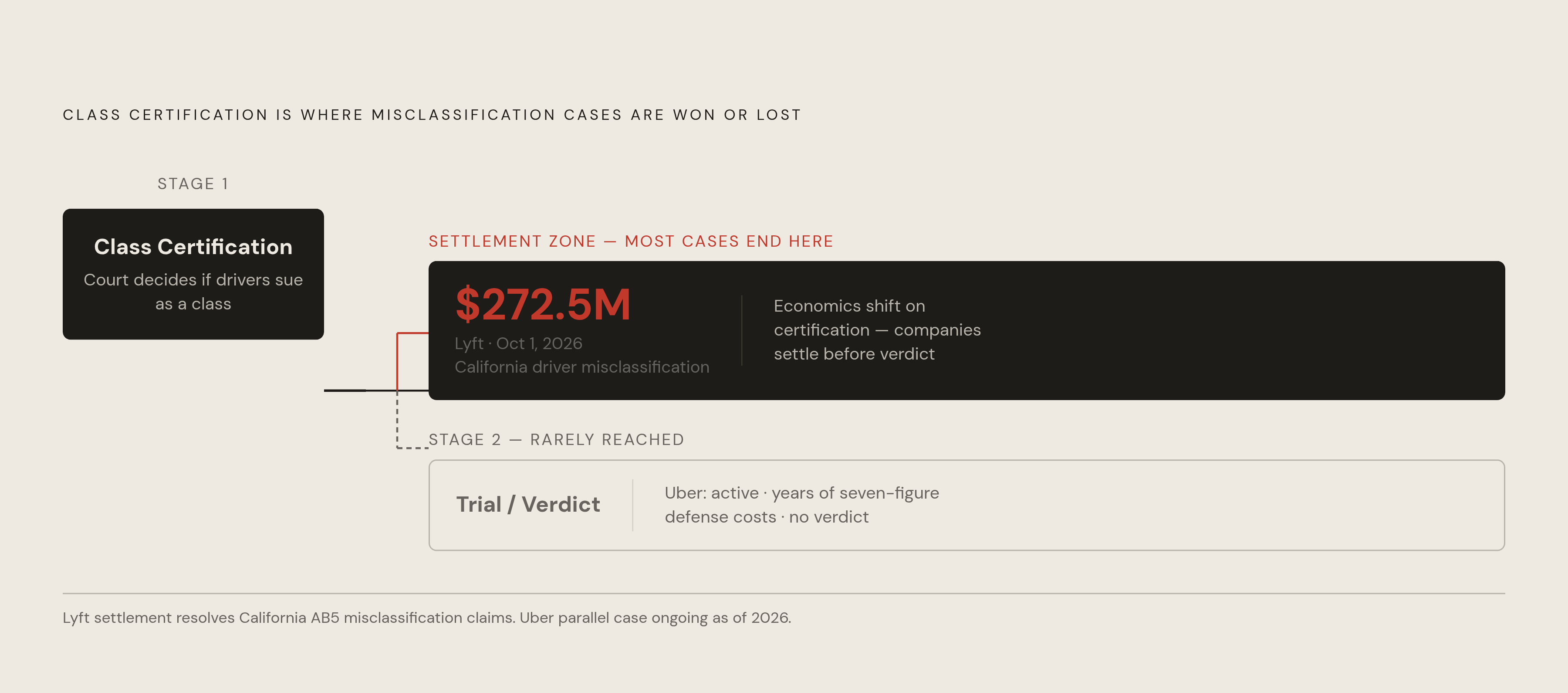
Once a class is certified, the economics of the case shift so sharply that most companies settle to avoid the risk of trial. That makes certification, not the eventual verdict, the moment that functionally decides the outcome.
The scale of that exposure is not hypothetical. Lyft agreed on October 1, 2026, to pay $272.5 million settling a California Labor Commissioner lawsuit over driver misclassification covering the period from April 5, 2016, through December 15, 2020, resolving claims for denied minimum wage, overtime, rest-break premiums, and business expense reimbursement. A parallel lawsuit against Uber, filed by the same Labor Commissioner's office in August 2020 on an identical legal theory, remains active as of October 2026 and is currently stalled in an arbitration dispute before the California Court of Appeal. Uber's case shows that even without a settlement, years of litigation impose their own cost in legal fees, management attention, and reputational drag.
Settlement figures are the headline number, but defense costs alone can run into seven figures before any settlement is reached, and that is before accounting for what a multi-year case does to an organization's operational focus. Classification risk also appears in places that have nothing to do with courtrooms. Investors conducting due diligence routinely flag contractor classification issues, and unresolved exposure in this area can slow down a funding round or complicate an acquisition before a single lawsuit is ever filed.
The shifting 2026 regulatory landscape
Federal classification policy is in motion, and operators should not assume that motion favors them. In February 2026, the DOL went further, proposing a rule under RIN 1235-AA46 to rescind and replace the 2024 rule. That proposal was not final as of the most recent reporting, and the enforcement bulletin changes nothing about private lawsuits: the 2024 rule still governs how courts evaluate classification claims brought by workers, regardless of what DOL investigators are told to do.
States are not waiting for federal regulators to settle this. On May 5, 2026, the New Jersey Department of Labor and Workforce Development announced final regulations, effective October 1, 2026, addressing how the ABC test applies to independent contractor status under the state's Wage and Hour Law and Wage Payment Law, making an already demanding test harder for IC-model businesses to satisfy. The Tomasello decision from that same May pushed New Jersey's ABC test into new territory, holding that the livestream performers failed Prong B because their work sat within the employer's usual course of business and was performed within what the court treated as the company's virtual footprint. Not every regulatory move cuts the same direction: Georgia passed legislation providing that voluntary employer contributions to an independent contractor's portable benefit account do not, by themselves, convert the contractor into an employee or the company into an employer. It is a narrow and early example of states trying to carve out compliance-friendly space without reclassifying anyone, but it is the exception in a landscape that is otherwise tightening.
Operational decisions that build or reduce certification exposure
The practices most likely to hand plaintiffs a commonality argument are often the same practices a company adopted for ordinary, defensible operational reasons. That overlap is the whole problem, demanding deliberate design to reduce exposure before the fact.
Certain practices reliably strengthen the case against an operator. Non-negotiable flat fee structures eliminate any market-based independence on the contractor's side, and that fact appears directly in the Dlivrd complaint as evidence of control. Company-provided training and direction on how to perform the work satisfies the supervision element under either test and does particular damage under ABC Prong A.
Other practices cut the other way. Documented contractor autonomy over scheduling, routing, and work methods applies the classification test contractor by contractor instead of letting it apply uniformly across the class. None of this is about finding a loophole. It is about understanding which operational choices generate the evidence plaintiffs need and which ones deny it to them.
Real-time compliance monitoring and documented contractor autonomy
A signed contract and a favorable jurisdiction will not stop a certification motion by themselves. What stops it is a compliance infrastructure that continuously documents the genuine independence of each contractor relationship, producing a record that makes the "common policy" story harder for plaintiffs to tell.
Compliance documentation functions as a litigation-prevention tool, not a filing exercise for the back office. The indicia plaintiffs collect to establish commonality, fixed schedules, direct supervision, exclusivity, platform-set pay, are the exact facts a real-time monitoring system should be tracking and, wherever the business model allows, structuring away from. Annual or quarterly audits are too slow for this purpose: by the time a periodic review surfaces a compliance gap, months of uniform-control evidence have already accumulated into the class-wide record plaintiffs need. Continuous monitoring catches that drift before it becomes a pattern. At the scale most IC networks operate, hundreds or thousands of contractors, manual back-office review simply cannot keep pace with that monitoring cadence. Automation at this stage is a structural requirement for any operator managing volume large enough to attract class action attention.
Onboarding is the first and best opportunity to build this record. For delivery networks in particular, occupational accident insurance and properly structured commercial auto coverage do double duty: they protect the business operationally, and they form part of the compliance architecture that distinguishes a genuine IC relationship, where the contractor carries independent coverage, from an employment relationship, where the company provides workers' compensation.
Takeaways for IC-network operators from the 2026 class action landscape
The certification standard is not a mystery and it is not arbitrary. Courts certify classes when uniform company policies create a common legal question, and operators who understand that logic can manage it.
The 2026 docket makes clear this is not a delivery-industry problem alone. The same classification theory behind Lyft's $272.5 million settlement is already hitting AI firms, other delivery platforms, and a widening range of IC-dependent businesses. The exposure is not sector-specific, and the companies most exposed are the ones treating classification as a decision made once, at contract signing, instead of an operational posture that has to be maintained continuously. Jurisdiction still matters enormously: operating in ABC-test states, California and New Jersey above all, demands a materially different compliance posture than operating solely under the economic realities test, and both states are moving toward tighter enforcement.
The practical priorities fall out from everything above. Audit current workforce practices against the specific factors courts actually examine for commonality, not just the language of the contractor agreement but the operational record of how contractors are dispatched, tracked, compensated, and managed. Build onboarding infrastructure that documents each contractor relationship's independence at the moment it begins, tailored to that specific relationship. Put real-time compliance monitoring in place so practices that build commonality evidence get caught and corrected continuously, before they surface years later during discovery. Make sure the contractor's insurance stack, occupational accident coverage and commercial auto among them, actually reflects genuine IC status and closes the coverage gap that a misclassification finding would otherwise tear open.
The sharpest point in all of this is the one most operators miss: the companies most exposed to certification are frequently the ones that standardized their contractor management most aggressively in pursuit of efficiency, because the same uniformity that makes a network scalable is the uniformity that makes class-wide proof achievable for plaintiffs. The fix is standardizing the right thing: building the documentation of independence with the same rigor currently reserved for standardizing the conditions of control.