Back Pay and Damages Calculations in IC Reclassification Verdicts
Courts double reclassification damages automatically unless employers prove good-faith belief.

In Scalia v. CE Security LLC, a Department of Labor investigator calculated back wages of $2,015,901.25 owed to 292 misclassified spotholder employees. That number, on its own, is the kind of figure that a budget memo absorbs without flagging. The trouble is that back wages are rarely the final number. If liquidated damages apply, they can match the wage award dollar for dollar, so the number a company planned for and the number a court orders can look nothing alike. If you model reclassification risk as a single wage gap, you have modeled the wrong problem.
The base layer: how unpaid wages and overtime are calculated after a reclassification finding
Start with the number everyone assumes is fixed: the gap between what a worker was paid as a contractor and what they were legally owed as an employee. Even this foundation moves, because the formula you use to calculate overtime inside that gap is itself a contested variable. Standard FLSA overtime pays a premium rate for hours worked beyond 40 in a week, and most operators assume this is the rule a court will apply if reclassification goes against them. But a second method exists, the fluctuating workweek approach, which kicks in when a court finds a clear mutual understanding that a fixed weekly payment was meant to cover all hours worked, however many. Under that method, overtime pays only a fraction of the regular rate above 40 hours instead of the full premium, and that can cut the back-wages figure substantially compared to the standard calculation.
Every federal appeals court that has ruled directly on this question, the 1st, 4th, 5th, 7th, and 10th Circuits, has accepted the half-time method in misclassification cases. The 7th Circuit reached the result not through the fluctuating workweek regulation itself but through the older Supreme Court doctrine in Overnight Motor. The legal reasoning varies by circuit, but the outcome is consistent, and that consistency makes the choice of calculation method one of the most heavily contested issues in reclassification litigation, well before anyone adds a dollar for benefits, taxes, or penalties. For delivery operators, this base layer carries one more wrinkle: per-stop or per-route pay structures that look adequate on paper can fall below minimum wage once a driver's own fuel and vehicle costs are subtracted, and that shortfall gets folded into the same base calculation.
The expense layer: how contractor cost-shifting converts into employer liability
Delivery companies built on the contractor model routinely make drivers pay for their own fuel, vehicle maintenance, and commercial auto insurance. That arrangement works fine as long as the drivers are legally contractors. Once a court or agency reclassifies them as employees, every one of those out-of-pocket costs retroactively becomes something the company should have been covering, and plaintiffs' lawyers treat that gap as its own line item in the damages calculation, separate from wages and overtime.
Cost-shifting tends to blindside last-mile operators specifically, because it is rarely the product of a single compliance decision. It's baked into the business model from day one: lower per-stop rates, explicit expense deductions, a pricing structure built around the assumption that drivers absorb their own overhead. None of that looks like a legal risk when the classification holds. All of it becomes a liability the moment the classification doesn't. Any delivery network that prices its contractor relationships around cost-shifting is, whether it knows it or not, building a line item that a court can quantify and award retroactively.
The tax layer: employer-side liabilities that surface alongside private claims
Reclassification doesn't stop at private wage claims. It also triggers the employer's share of Social Security and Medicare taxes that were never remitted, because misclassified contractors were paying both the employee and employer portions of self-employment tax out of their own pockets. Once a worker is reclassified, the company owes the employer's half retroactively, and that adds a separate percentage on top of everything already owed in the base and expense layers.
The part operators underestimate is this liability's independence from everything else in the stack. The IRS pursues employer-side tax exposure on its own track, apart from any Department of Labor investigation or any lawsuit a group of drivers might file. A company can settle a wage claim and still face a tax assessment running in parallel, because nothing about resolving one track closes the other. That independence is the operational lesson: a single enforcement trigger, like one driver filing an unemployment claim, can set multiple agencies in motion at once, each with its own formula and its own number to arrive at, none of which offsets the others.
The multiplier layer: how liquidated damages and state penalties double or triple the total
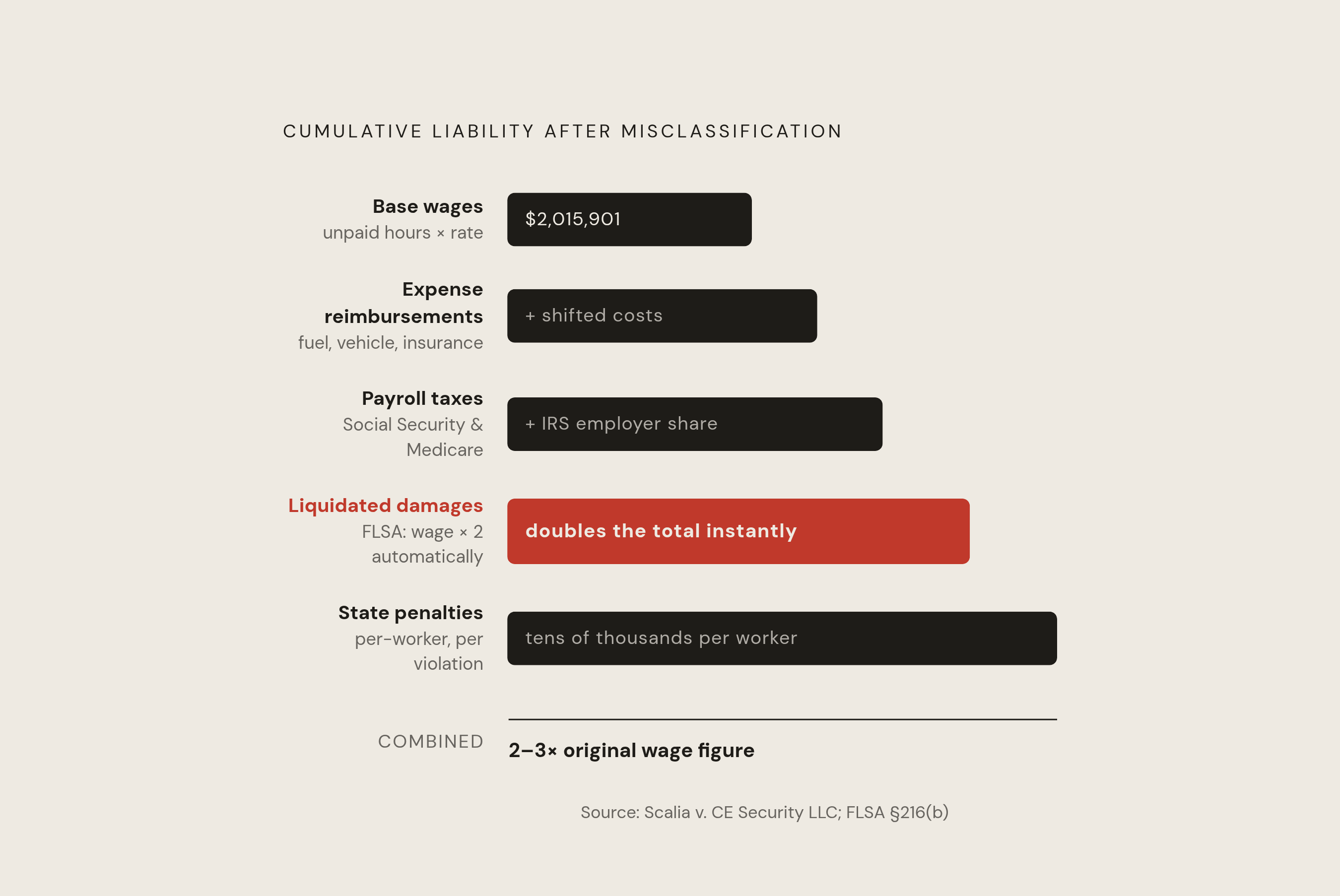
The FLSA's liquidated damages provision is the single most reliable way a reclassification number doubles overnight. The statute allows liquidated damages equal to the full amount of unpaid wages, and courts award them automatically unless the employer can affirmatively prove it acted in good faith and reasonably believed its classification was lawful. The burden sits with the company, not the plaintiff. A business doesn't need to show it did something wrong to get hit with the doubling. It needs to prove it did something right, and that is a much harder bar to clear after the fact.
CE Security LLC shows how mechanical this doubling can be. The back-wages calculation invited a liquidated damages claim matched dollar for dollar against it, and no separate factual finding was needed beyond the underlying misclassification itself. If a court finds the misclassification, the liquidated damages follow almost automatically, and that is what turns a single wage calculation into something closer to double its original size.
State penalty regimes stack on top of that federal doubling if you work in stricter jurisdictions. A state's labor agency can impose its own penalties for intentional misclassification, and those can reach tens of thousands of dollars per worker. If you apply that per-worker penalty across a delivery fleet of any meaningful size, the state penalty layer alone can rival the original wage calculation. Liquidated damages roughly double the wage award, and state penalties, where they apply, can push the total higher still, which is the mechanism behind the "two to three times" framing operators should use to think about total exposure.
How the insurance structure gets repriced when classification changes
Reclassification doesn't just produce a damages figure. It quietly invalidates the insurance program a company built to cover its contractor fleet. Occupational accident insurance is the standard coverage for 1099 gig delivery workers, and it's built around the assumption that the covered person is a contractor. It cannot substitute for workers' compensation once a court decides those same people are employees, and no amount of good-faith purchasing history can change that retroactively.
This creates a genuine bind for platforms that try to manage risk on both sides. Extending workers' compensation coverage to contractors, as a hedge against exactly this scenario, can itself be read by a court as evidence that the company already understood those workers to be employees. Occupational accident insurance is the right product for a workforce that is genuinely independent, and workers' compensation is the right product for a workforce that is genuinely employed, and the classification decision is what determines which of those products is even legally defensible after the fact. There's no version of "buy both and stay safe," because the act of buying the employee-side coverage can undercut the contractor-side classification it was meant to protect.
If you run occupational accident insurance across a large contractor base, the sharpest version of this problem occurs after a reclassification verdict covering an entire period of misclassification. Every injury claim from that period becomes a potential workers' compensation claim, and no occupational accident policy will pay out on it, because those policies are underwritten for contractors, not employees. The insurance program a company thought was covering its risk turns out to have been covering a different risk.
What the 2026 federal rule change does and does not fix for delivery operators
The Department of Labor proposed a rule in February 2026 that reestablishes a five-factor economic reality test with two factors weighted more than the rest, and this shift reads as more favorable to the independent contractor model than the standard it replaces. Operators who read that announcement and conclude their classification risk has dropped are making a mistake rooted in geography. Federal rules govern federal wage law. They do not reach the state courts and state labor departments where the largest reclassification verdicts in the delivery sector have actually landed.
California, Massachusetts, and New Jersey all run ABC tests or similarly strict standards that ask harder questions than any federal economic reality test ever will, and nothing in the 2026 federal rule changes that. New Jersey went further that same year: it issued final ABC test regulations that take effect October 1, 2026, tightening one of the most heavily litigated state standards in the country just as the federal government loosened its own. The PDX North settlement in New Jersey, announced in March 2026, and the NFI Interactive Logistics settlements from August 2025, both arose entirely under state law frameworks the new federal rule has no power to touch. A delivery operator that reads the DOL's 2026 rule as a reason to relax has looked at the wrong map; the exposure lives in state courts, and the federal shift changes none of it there.
One genuinely new development runs in the operator's favor. New Hampshire's HB 1245, signed July 2, 2026, lets companies offer portable benefit plans to independent contractors, and that offer does not count as evidence that the worker is actually an employee. It's one of the first state laws to formally separate benefit access from classification status, and it matters for any operator trying to make contractor work more attractive without accidentally arguing itself into an employment relationship in the process. It's a narrow fix in one state, but it points toward the kind of legislative solution the rest of the country has largely avoided.
From Damages Architecture to Operational Compliance Posture
Lay the full stack side by side, wages, overtime methodology, expense shifting, tax exposure, liquidated damages, state penalties, and insurance restructuring, and classification compliance stops looking like a legal formality and starts looking like a balance-sheet risk with a calculable ceiling.
The trigger points are rarely dramatic. The PDX North action, which produced one of 2026's largest state-level settlements, began with a single driver filing for unemployment benefits, not a lawsuit, not a whistleblower, not a congressional hearing. One filing opened a comprehensive audit, and that audit is what surfaced the full scope of the company's exposure. A single contractor complaint, or one routine audit, can open Department of Labor, IRS, and state agency tracks simultaneously, and each of those tracks is authorized to award its own separate layer of damages regardless of what happens on the others.
For delivery companies running contractor networks at real scale, the practical response is continuous monitoring of the same details that generate this exposure: credential status, insurance verification, payment timing, and the structural question of whether per-stop pay still covers the floor once driver expenses are counted. Reclassification risk accumulates in the gap between when a compliance failure occurs and when someone notices it. Closing that gap from months to days is the operational difference between a company that manages this risk and one that discovers it in a courtroom.