State Unemployment Insurance Audits Targeting Gig Delivery Companies
Audits in six states are exposing delivery companies to massive back-pay and penalty bills.

Most delivery operators treat a state unemployment insurance audit the way they treat a smoke-detector inspection: a formality, a box someone checks, nothing that changes the shape of the business. That assumption is wrong, and it is wrong in a specific, expensive way: the volume and variability of contractor arrangements make misclassification easy to allege and expensive to defend. The mechanism is volume. A company with a hundred contractors has a hundred classification decisions that could be challenged, and a larger company has correspondingly more, each one a potential thread an auditor can pull. New York's Department of Labor is required by federal unemployment insurance standards to audit a set percentage of businesses every year, and while most of those audits are routine and the businesses are picked at random, the pool is large enough that delivery companies with high contractor headcounts turn up in it constantly, just by the math of scale. Arizona runs the same kind of routine audit program through its Department of Economic Security, and its auditors have to look specifically at whether workers are properly classified as employees and whether the payments they receive count as wages, and fluctuating app-based income is flagged as a documented trigger.
What a misclassification finding actually unlocks makes this worse than a paperwork headache. It does not stop at an unemployment insurance bill. A single finding cascades into back wages, unpaid overtime, years of payroll taxes that were never withheld, and penalties that can land simultaneously from the Department of Labor, the IRS, and the state agency that started the audit in the first place. Courts and auditors alike have moved toward judging the reality of the working relationship rather than the label on the contract: who assigns the routes, who sets the schedule, what the app requires, who owns the equipment. Every operational decision a delivery company makes to run efficiently becomes, in an audit, a piece of evidence about control, whether the company intended it that way or not.
How the states that audit most aggressively test classification
Federal policy has moved in a direction that is friendlier to independent contractor classification, but that shift does not reach into the states where most delivery volume actually runs, because those states run their own tests and federal policy cannot override them. In May 2025, the Department of Labor issued Field Assistance Bulletin 2025-1, and it told investigators to stop applying the 2024 rule from the prior administration and go back to the older economic reality test. Then, on February 26, 2026, the DOL went further and proposed a rule that could make it easier to qualify as an independent contractor under a simplified two-factor standard. Operators who read that sequence as a green light are reading only half the page.
California's ABC test puts the burden on the company, not the worker, to prove proper classification, and if the company fails even one of the three prongs, the worker has to be classified as an employee. The Ninth Circuit upheld AB 5 on June 10, 2024, so that closed off one avenue of challenge. Proposition 22 carves out an exemption for app-based rideshare and delivery platforms specifically. That exemption does not extend to couriers, B2B logistics operators, or delivery businesses that are not structured as app-based platforms, which leaves a wide swath of the industry fully exposed to the ABC test's default rule. New Jersey has already shown what that exposure looks like in practice: its Department of Labor and Workforce Development found that Uber violated the state's ABC test and issued an assessment resulting in a substantial settlement, comprising the majority in past-due tax contributions and the remainder in penalties and interest. That outcome happened, not as a hypothetical warning.
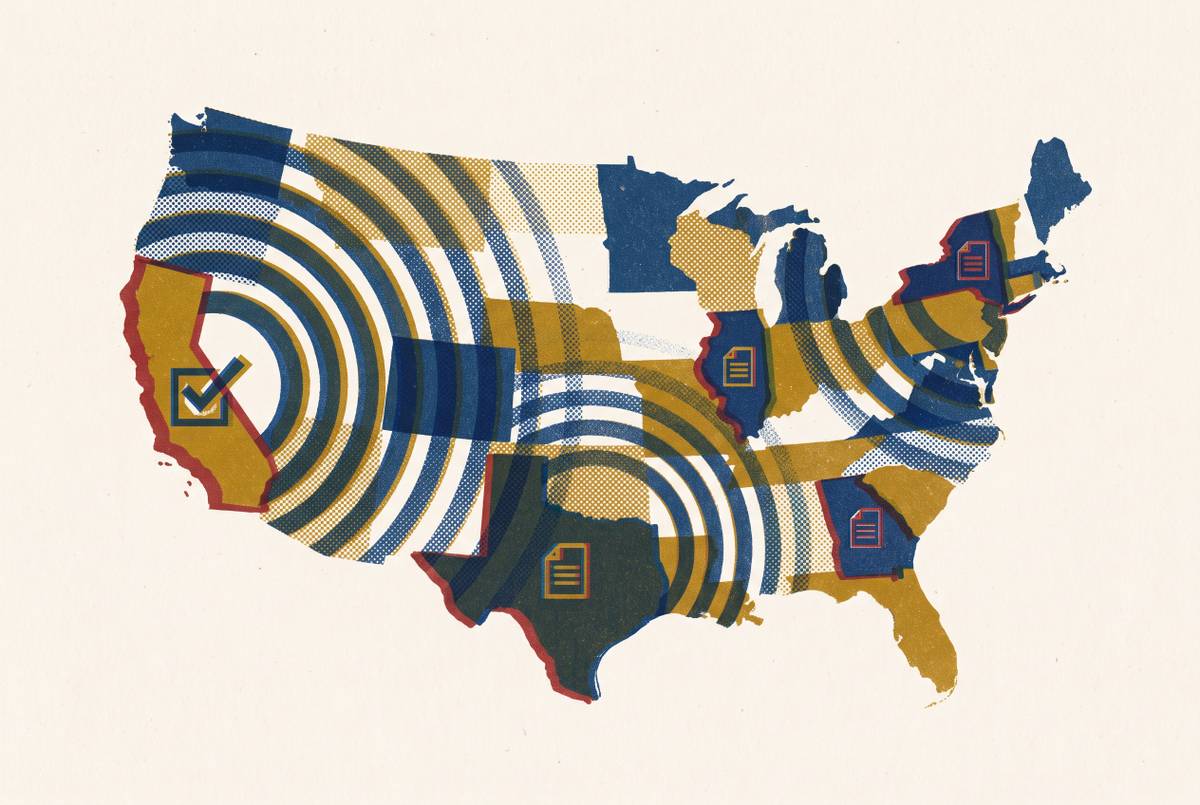
The states running the most aggressive UI audit programs, California, Illinois, Massachusetts, New Jersey, New York, and Pennsylvania, are not a random assortment. The DOL OIG says they are the same states that issued more than $2.6 billion in improper unemployment insurance benefits in fiscal year 2025, so their labor departments have both a budget reason and a political mandate to audit harder. Compounding the picture further, the 2024 federal independent contractor rule remains fully active for private litigation purposes even while federal enforcement has eased off. Delivery companies are operating under two legal regimes at once: a relaxed federal enforcement posture on one hand, and full exposure to state ABC tests and private class action lawsuits on the other.
The cost of a multi-year audit sequence: the PDX North case
The PDX North settlement is the clearest illustration of what a drawn-out UI audit sequence costs a last-mile delivery operator, and the numbers and timeline are instructive. PDX North, Inc., a last-mile automotive parts distribution company, agreed to pay a multi-million-dollar settlement to resolve a worker misclassification case covering more than a thousand delivery drivers, brought by the New Jersey Department of Labor and Workforce Development alongside the New Jersey Office of the Attorney General. The March 2026 agreement resolved four audits, stacked across years 2006 through 2019, more than a decade during which the company classified its delivery drivers as independent contractors in violation of New Jersey's unemployment compensation and temporary disability benefits laws. The settlement figure was not the end of the cost. PDX North also agreed to reclassify its delivery drivers as employees going forward, so the company now pays a permanently higher cost on top of whatever it spent to close out the past.
PDX North is not an isolated data point. The Lawson v. Grubhub, Inc. class action followed a similar arc through a different legal channel: a California delivery driver's misclassification claim that took roughly a decade to resolve, reaching a substantial settlement agreed in 2024 and finally approved in January 2026. And the exposure is not confined to consumer-facing apps. Lab Logistics LLC, a courier business serving medical laboratories, hospitals, and health systems, faced a proposed class action alleging it misclassified couriers as independent contractors and failed to pay overtime required under the FLSA and Colorado wage and hour law. Medical logistics and B2B courier operations are squarely in scope. The pattern across all three cases is the same: audits start as routine inquiries, stretch across years, and accumulate liability that dwarfs whatever it would have cost the company to build proper classification documentation from day one.
How auditors classify a delivery contractor as an employee
Auditors are grading the operation, not the contract, and delivery companies generate the exact fact pattern auditors are trained to look for, often without realizing it. Under the economic reality test that federal investigators now apply following Field Assistance Bulletin 2025-1, the relevant factors are opportunity for profit or loss, the worker's own investment in tools and operations, how permanent the relationship is, the degree of control exercised over the work, whether the work is integral to the business, and the worker's skill and initiative. For a delivery company, the control factor is the exposed one: route assignment, app-mandated procedures, uniform or vehicle requirements, and company-set schedules all read as employer control under this framework, regardless of what any onboarding document says.
Under the ABC tests that California, New Jersey, and Massachusetts apply, the exposure is structural rather than behavioral. The middle prong requires the company to show that the contractor's work falls outside its usual course of business, and for a delivery company, that is close to impossible to establish, because delivery is the business. If the record shows company-set schedules, company-directed routes, and company-supplied equipment, then labeling someone an independent contractor in an agreement does not hold up. The classification fails on the facts regardless of what the paperwork says. Delivery apps pay variable, fluctuating income, and that swing itself is a documented audit trigger, because weekly pay swings look more like a misclassified worker than an independent business with its own client base. Quality control requirements, training mandates, and behavior standards enforced through the app appear in an audit file as evidence of control. The more closely an operator manages contractor performance, the more that management becomes exhibit material, unless the operator also has documentation that actively establishes the contractor's independence.
The insurance gaps that a misclassification finding rips open
A misclassification finding does not just generate a tax bill. It reaches backward in time and triggers workers' compensation and benefits obligations that the company never budgeted for, because those obligations are retroactive to the period the audit covers. When a delivery is active, a platform's occupational accident policy typically covers medical costs from an on-trip incident. Between deliveries, between apps, or off the clock, that coverage generally provides nothing, and personal auto insurance policies commonly exclude delivery driving. California already requires app-based transportation and delivery companies to carry occupational accident insurance covering medical expenses and lost income from work-related injuries, and failing to meet that kind of state-specific mandate compounds whatever liability an audit later produces.
The operational baseline for closing these gaps involves layering coverage rather than relying on a single policy: occupational accident insurance for the window when a delivery is active, commercial auto liability for the vehicle exposure, and cargo insurance for goods in transit, each one covering a distinct hole that a retroactive employee finding would otherwise force the company to absorb directly. Operators who go into an audit already carrying that layered coverage have something useful on the table: documentation showing that contractors carry their own risk, which reinforces independent contractor status and limits how much additional liability a reclassification finding can pile on. The reverse is just as true. An operator with coverage gaps faces all three liabilities landing at once if the finding goes against them: back taxes on the unemployment insurance side, workers' compensation obligations that apply retroactively, and uninsured injury claims that were never supposed to be the company's problem.
What federal oversight infrastructure is doing in 2026
Federal UI oversight is building the infrastructure that will make misclassification easier to catch at scale in 2026, and that infrastructure will outlast whatever enforcement posture the current administration happens to favor. On April 27, 2026, the DOL OIG announced it was opening an audit to check whether states properly used more than $204 million in UI IT modernization funds to strengthen and secure their systems, and a final report is expected in the third quarter of fiscal year 2027. Inspector General Anthony P. D'Esposito framed the problem bluntly: states that took the modernization money while still blaming "outdated IT infrastructure" and ignoring requests for action created a disconnect that "demands accountability," and the audit is designed to follow the money and establish whether states actually modernized or just kept the lights on. That audit sits inside a larger effort, the President's Task Force to Eliminate Fraud, which brings federal partners together to find vulnerabilities in the UI program and tighten oversight under an explicit framing of going "on offense".
The point of all this modernization is prevention. The DOL OIG's broader UI oversight work is aimed at catching improper payments before they happen rather than clawing them back afterward. Modernized state systems are being built specifically to flag employer-level irregularities earlier in the process. The April 2026 IT audit is not a one-off. It runs alongside a January 26, 2026 audit of pandemic-era UI programs, and together they signal a sustained, escalating posture. The practical consequence for a delivery operator is straightforward: as state systems modernize, the cross-referencing of 1099 payment data against unemployment insurance claims, already a known audit trigger, gets faster and more automated, shrinking the gap between a misclassification pattern forming and an audit notification arriving. Relaxed federal enforcement language is the calm before a better-instrumented storm.
How robust classification documentation makes audit scrutiny manageable
Operators who keep continuous, timestamped records of every contractor relationship walk into an audit with their evidence already assembled, which turns the audit from a search for liability into a demonstration of compliance. Much of the exposure described in earlier sections is really an onboarding and record-keeping problem. Without structured documentation showing how a contractor was engaged, how they set their own schedule, what tools they supplied themselves, and how they were paid, the factual record defaults to whatever the auditor happens to observe, and what an auditor observes is often evidence of control rather than evidence of independence.
What an auditor requests during a review, the covered time period, business records from that period, and payment records sorted as wages or non-wages, lines up closely with what a well-structured onboarding and credentialing process produces as a byproduct of normal operations: timestamped contractor agreements, credential records, payment logs, and dispatch records. Automating that audit trail is a concrete compliance measure rather than an aspiration: systems that timestamp every dispatch decision, every contractor assignment, and every credentialing event generate the paper trail a UI auditor needs to confirm independent contractor status, or that a state would need to force a reclassification. For operators running across multiple states, the documentation has to flex to satisfy different legal tests at once; a single standardized onboarding module that captures the facts relevant to an ABC test, independent business status, ownership of tools, work for other clients, control over one's own schedule, gives every state's auditor the same clean record regardless of which test that state applies.
Continuous monitoring beats periodic review as an operational standard: credential expirations, insurance lapses, and shifts in working patterns that bear on classification should be flagged as they happen rather than discovered for the first time when an auditor opens a file. Pay structure sends a compliance signal too, and it goes beyond contractor satisfaction. Earned wage access paid per delivery, through debit or same-day ACH, reinforces the economic independence that courts look for under the economic reality test, because a contractor paid job by job presents a cleaner independent contractor profile than one receiving regular, wage-like disbursements on a fixed schedule. A workforce management system that handles onboarding, credentialing, insurance enrollment, compliance monitoring, and payment in one place produces an integrated audit trail that a manual back-office process cannot match without adding staff purely to keep the paperwork current.
The practical steps a delivery
If you operate here, you face a narrower set of real options than the legal complexity might suggest. Audit the current contractor relationships against both the economic reality test and the relevant state ABC test before a regulator does it first. Build or buy a documentation system that timestamps onboarding, credentialing, dispatch, and payment records automatically, since manual record-keeping cannot keep pace with contractor volume at any meaningful scale. Layer insurance coverage, occupational accident, commercial auto, and cargo, so that a retroactive employee finding does not land on top of an existing coverage gap. Treat the current federal enforcement pause as temporary cover rather than permanent protection, given that state ABC tests, private litigation under the 2024 federal rule, and a modernizing UI data infrastructure are all converging on the same employers at the same time. The companies that treat classification documentation as a standing operational discipline, rather than a response to a letter that has already arrived, are the ones that will read about PDX North's settlement as a cautionary tale instead of a preview.
Sources
- Labor Law Compliance for Gig Workers: Employer Guide 2026
- OIG Press Release - Labor Department Watchdog Announces Unemployment Insurance Information Technology Audit
- Press Releases - DOL-OIG - U.S. Department of Labor
- Unemployment Insurance Audits for Businesses | Department of Labor
- DOL 2026 Gig Worker Classification Changes Explained