Prop 22 Successor Legislation in Other States
States are copying California's Prop 22 template with costly divergences in pay, benefits.
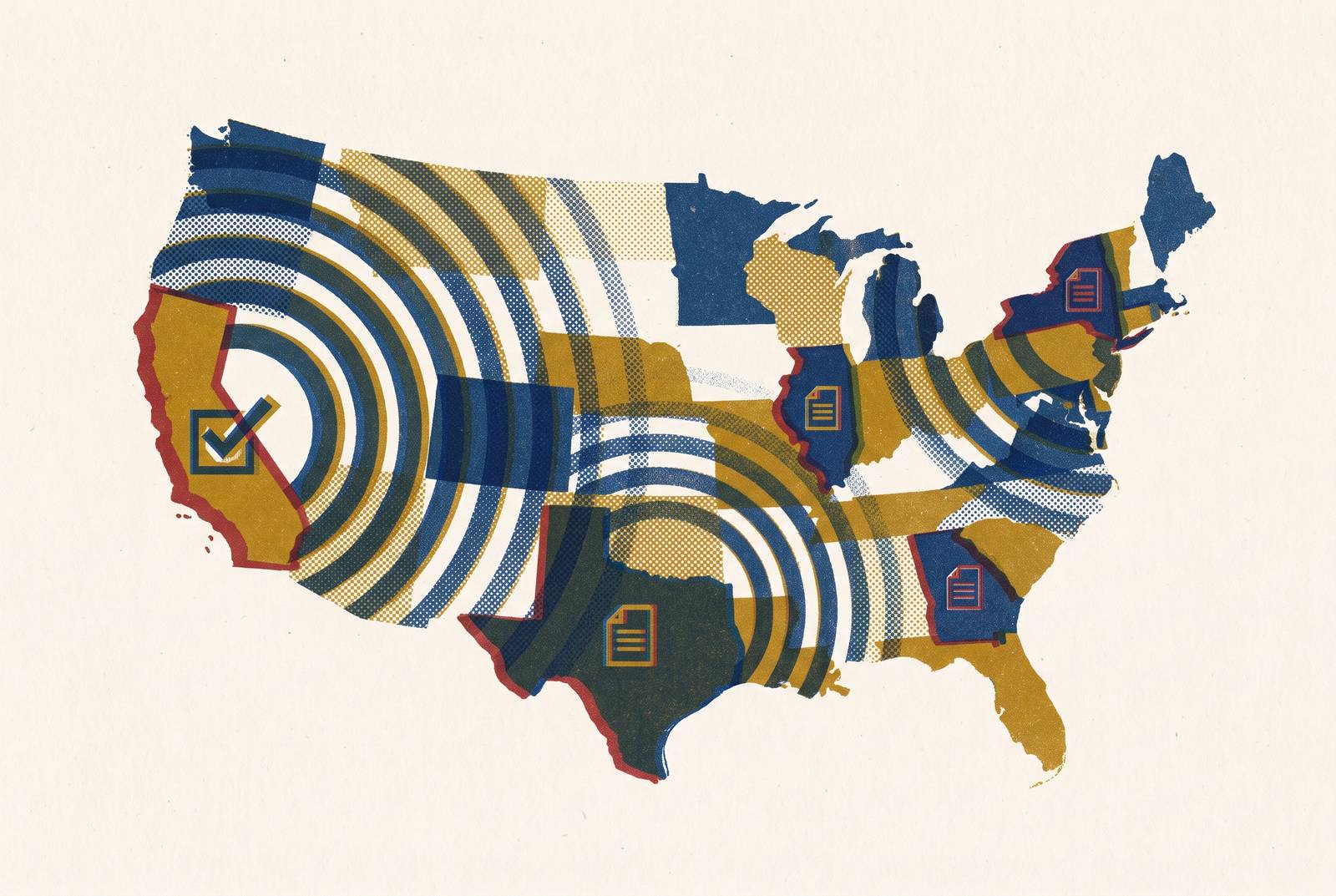
Prop 22 set a replicable template for carving out app-based delivery and gig workers as independent contractors with baseline protections, and state legislatures have since been pursuing their own versions with different tradeoffs between contractor flexibility, worker benefits, and platform obligations. A driver's legal status, pay floor, and benefit rights change at the state line, sometimes at the city line, and IC-network operators running multi-state fleets have to track all of it at once.
Prop 22 and its creation of a template
California voters passed Prop 22 in November 2020 with 58.6% in favor, after platforms poured more than $200 million into the campaign, making it the most expensive ballot initiative in state history at the time. The mechanism was narrow but consequential: it carved app-based delivery and rideshare drivers out of AB 5's employee-classification test, letting them stay independent contractors while attaching a floor of specific protections to that status, a direct tradeoff written into the law itself.
Three protections make up that floor. Drivers get an earnings guarantee of 120% of minimum wage for engaged time, plus a per-mile supplement calmatters.org. They get a healthcare subsidy of up to $367 a month, but only if they average at least 25 engaged hours a week over a quarter parris.com. And they get occupational accident coverage, which walks and talks like workers' comp without actually being workers' comp.
The reason other states keep copying this isn't mysterious: it threads a needle nobody thought was threadable. Platforms keep contractor classification, workers get defined minimums instead of nothing, and legislatures get to dodge the all-or-nothing fight between full employee status and no protections at all. That's a politically comfortable middle, which is exactly why it travels.
Durability sealed the deal. The California Supreme Court upheld Prop 22 in Castellanos v. State of California on July 25, 2024, rejecting a labor-union constitutional challenge, which told every other statehouse watching that the model isn't just popular, it survives court.
What Prop 22 leaves unaddressed is where the real divergence starts. It is silent on drivers working multiple apps simultaneously, on coverage during non-engaged time, and on enforcement mechanisms. Every successor state has had to answer those questions on its own, and the answers don't match. AB 1514 modifies some exemptions under California's broader classification regime, effective January 1, 2026, meaning operators in California still need to track state-level adjustments even after Prop 22 was upheld.
The federal classification backdrop that shapes what states can and cannot do
Federal rules set the floor, not the ceiling, and that floor has been sliding around for two years.
None of that changes what California, Massachusetts, or New Jersey already require. Federal flexibility does not preempt stricter state rules: California's ABC test, Massachusetts, and New Jersey maintain strict classification standards regardless of federal direction, and operators must always apply the most protective standard that applies. Two bills sitting in a legislative body would change that math if either clears: a chamber's Modern Worker Security Act from Rep https://www.govinfo.gov/app/details/BILLS-119hr1320rh. Kevin Kiley would stop federal agencies from treating benefit contributions as proof of an employment relationship, and it cleared the House Education and Workforce Committee in early 2026. The Senate's parallel, Sen. Bill Cassidy's Unlocking Benefits for Independent Workers Act (S. 2210), introduced in July 2025, carries the same safe-harbor language. Pass either one and platforms lose their standard excuse for not offering benefits, since offering them would no longer risk reclassification.
Because sources on where 1099 reporting thresholds will land disagree with each other, the safest thing to say is that the reporting floor is shifting, and readers should check it against the final IRS rule rather than repeating a specific number that may not hold. The DOL enforcement pause offers short-term flexibility, but states are moving in different directions, ensuring classification will remain a compliance priority through 2026 and beyond. The 2024 DOL rule applied a six-factor totality test without weighting any element more heavily, which often leaned toward employee status in ambiguous cases, and enforcement paused in May 2025. On February 26, 2026, DOL issued an NPRM to rescind the 2024 rule and replace it with a streamlined economic reality framework giving greater weight to specific indicators, published in the Federal Register on February 27, 2026.
Washington and Massachusetts: the two earliest successor models
Washington moved first, and it moved by negotiation rather than ballot box. Washington's law, signed in March 2022, was legislated rather than put to a ballot initiative, a brokered compromise between the platforms and the local Teamsters chapter, even as the union's national headquarters called on the governor to veto it. The law kept IC status intact but added minimum pay guarantees, paid sick leave tied to hours worked, and something Prop 22 never granted: a right to appeal a platform's decision to suspend a driver. That last piece matters operationally. It means suspension can't just be a quiet policy toggle flipped from a dashboard; it has to be documented and defensible, because a driver can contest it.
Massachusetts got to a similar destination by a messier road. Platforms spent a multimillion-dollar campaign trying to put a Prop 22 clone on the ballot; the state's Supreme Judicial Court knocked out an earlier version before it ever reached voters, and when a second version cleared to proceed anyway, Uber and Lyft pulled it themselves as part of a legal settlement. What they agreed to instead: a mandated minimum hourly wage, added benefits for drivers, and dropping their own ballot push, voluntarily, not because a court forced their hand a second time. Out of that settlement came a portable health fund launched in 2025, administered by Stride Health and funded by Uber and Lyft under a 2024 agreement with the state Attorney General, a state-run benefit mechanism rather than something the platforms built and control themselves.
Lining the two up shows the same lesson from opposite angles. Washington shows a negotiated deal splitting the labor movement it was supposed to satisfy; Massachusetts shows a ballot campaign that never even reached the voters it was aimed at. Both routes still ended in new, binding compliance obligations, which is the part operators can't afford to miss just because neither state produced a clean Prop 22 copy.
The 2025 portable-benefits wave: Tennessee, Alabama, Wisconsin, and the veto that defined the debate
Utah opened this door in 2023 with the first voluntary portable-benefits model, nine more states have introduced similar bills since, and three had actually passed legislation as of the most recent count. Tennessee is the cleanest of the three. The operative word is voluntary: platforms are allowed to do this, not required to, which makes it a safe harbor rather than a mandate.
Alabama passed its own version in 2025, following Utah's lead and landing in the same legislative window as Tennessee, though the specific bill language gets less coverage than the fact that it belongs to the same wave.
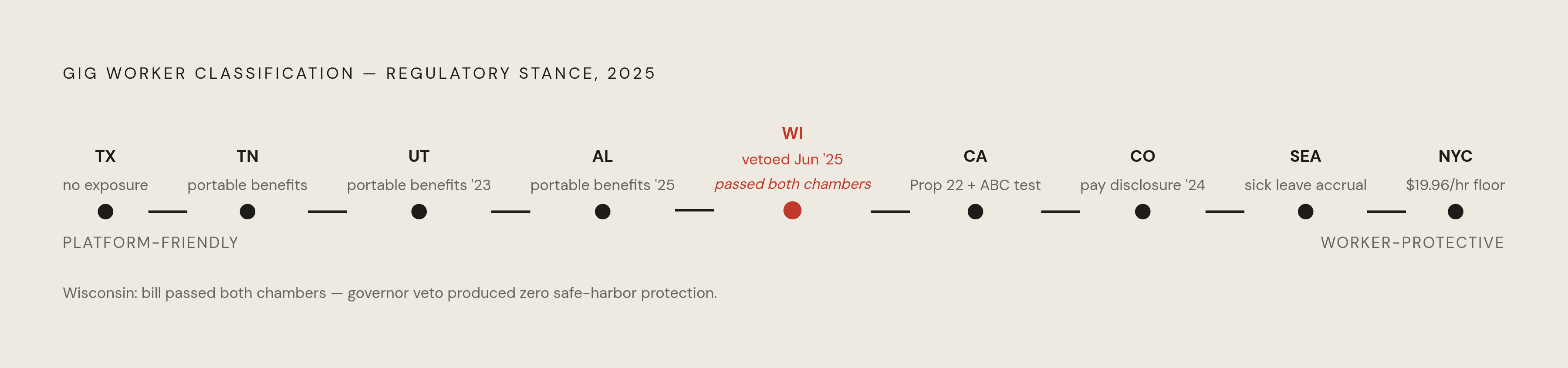
Wisconsin is where the wave hit a wall. Senator Julian Bradley's bill passed both chambers of the state legislature in June 2025 with votes from both parties, and it would have let platforms fund benefit accounts (health, dental, vision, retirement, income replacement) without triggering reclassification. Governor Tony Evers vetoed it anyway, objecting specifically to a bill that redefines what an independent contractor is without guaranteeing the worker anything in return. That veto crystallizes the central political argument against the Prop 22 model: critics, including the National Employment Law Project, characterize these bills as legitimizing misclassification rather than protecting workers. For operators, the practical result is a gray zone: no safe harbor in Wisconsin, no portable-benefits authorization, and the existing classification rules apply exactly as they did before the bill was ever drafted.
A quieter, sub-legislative track is running in parallel. Pennsylvania, Georgia, and Maryland have all had governors approve pilot programs run through the benefits company Stride, which sidesteps the need for a full statute. A Wisconsin Senate press release states that more than 88% of gig drivers cite flexibility and independence as their main reason for doing the work, showing that drivers on either side of this debate aren't fighting over whether to leave contractor status legis.wisconsin.gov. It's about whether they can get real protections while staying in it legis.wisconsin.gov. The act authorizes marketplace platforms to provide medical and other insurance benefits to gig workers and 1099 independent contractors.
States that moved in the opposite direction: pay floors, transparency rules, and hostile classification regimes
Not every jurisdiction is writing safe harbors. New York City set a minimum pay floor for app-based delivery drivers of at least $17.96 an hour, scheduled to climb to $19.96 by April 2025, with accrued paid sick leave layered on top. Seattle runs a similar sick-leave accrual system for app-based workers. Colorado took a narrower swing in 2024, requiring Uber and Lyft to disclose pay information to gig workers, a transparency rule rather than a floor, but still one more thing to build reporting around.
Texas went the other way entirely, structuring its rules so platform workers can almost never qualify for employee status or the wage protections that come with it. Illinois, Maryland, Minnesota, and New Jersey took a narrower tack, introducing bills that bar employers from clawing back certain expenses at the end of the relationship, a smaller rule but a real one for anyone running contractors across state lines. California and New Jersey have some of the steepest classification penalties, and most states are increasing enforcement budgets for 2026.
The geography isn't random. A contractor network with drivers in both kinds of state is complying with two philosophies of labor law at the same time, under the same corporate roof. The pattern holds: high-density urban markets, namely NYC, Seattle, and the Chicago corridor, trend toward pay floors, while Sun Belt and Mountain West states trend toward safe harbors, leaving operators with national contractor networks facing both simultaneously.
How the divergence affects IC-network operators running multi-state fleets
Classification isn't a decision an operator makes once and files away. Between the 2026 DOL NPRM, California's AB 1514 taking effect January 1, 2026, and active legislative sessions in multiple states, the applicable rules can change mid-year. Layering the specifics makes the scale of the problem concrete fast. California means Prop 22 protections for app-based work plus the ABC test for anything outside it, plus AB 1514's exemption changes landing in 2026. New York City means a per-delivery pay floor at $17.96, rising to $19.96, plus sick leave accrual. Tennessee means the option to offer portable benefits with no reclassification risk, an opportunity sitting on the table, not an obligation. Texas means almost no classification exposure but also nothing resembling a safe harbor to point to if challenged. Wisconsin, post-veto, means none of the above: no safe harbor, no portable-benefits law, standard classification analysis and nothing else.
Onboarding must be jurisdiction-aware: a contractor onboarded in Texas under one standard may be deployed in California under a different one, so onboarding needs to capture jurisdiction at the point of engagement, not months later in an audit.
Insurance follows the same jurisdictional split. Where Prop 22-style occupational accident coverage is mandated, as in California, the platform carries that obligation directly. Where no such mandate exists, the gap falls on the contractor's personal insurance, and personal auto or health policies routinely exclude commercial activity, leaving an injury during a delivery run uncovered unless the operator has closed that gap deliberately.
Pay speed turns out to be its own compliance line item, not just a nice-to-have for retention. Only around a third of gig platforms currently pay out instantly, according to PYMNTS; the rest run on weekly or biweekly ACH, and in jurisdictions with pay-timing rules on the books, a delayed payout can create wage liability even when the per-delivery rate itself is fully compliant. And the pressure isn't only domestic: the EU's Platform Work Directive requires member states to write a rebuttable presumption of employment into national law by December 2, 2026, which doesn't bind U.S. operators directly but tells anyone eyeing international expansion which way the regulatory wind is blowing.
Building compliance infrastructure that keeps pace with a jurisdiction-by-jurisdiction patchwork
A manual compliance process that works in one state fails in three states and breaks entirely at scale, because every new jurisdiction adds a new matrix of classification rules, pay floors, benefit obligations, and credential requirements.
Credential and compliance monitoring has to run continuously, not on an annual cycle, because legislative moves in states like Wisconsin, Illinois, and New Jersey can outpace any audit schedule built around a calendar year. Insurance needs to be structured for the actual IC relationship, occupational accident and commercial auto coverage that matches engaged time as each state defines it, with coverage periods documented clearly enough to close the exact gap personal insurance leaves open; buying that coverage in bulk across a large contractor network also brings the per-contractor cost down in a way that matters at scale. Payments need same-day ACH or instant debit as the standard offering, not an upsell, since pay-timing rules in places like New York City turn payout speed into a compliance question and not just a driver-satisfaction one; NACHA reports Same Day ACH volume grew substantially in the first quarter of 2026, so the rail to do this already exists.
None of this reads as an argument for retreating from contractor classification. The 2026 DOL NPRM, the California Supreme Court's Prop 22 ruling, and Tennessee's Voluntary Portable Benefit Plan Act all point toward a federal and state-level openness to IC classification, but only when operators can demonstrate the relationship is structured correctly and documented consistently. Portable benefits, in that light, look less like a compliance tax and more like a recruiting edge: in states with safe-harbor laws already on the books, Tennessee and Utah now, potentially the federal government later, operators who offer health, dental, or retirement contributions through portable accounts differentiate themselves to drivers without touching their contractor status at all.
The through-line from Prop 22 to the 2025-2026 state wave is that every successor law adds a new compliance variable for operators to track, whether a mandate like the NYC pay floor or a safe harbor like Tennessee's portable benefits act. Treating each new law as a one-off policy update leaves the backlog never clearing. Building the monitoring and adjustment capacity into the operation itself turns the same regulatory mess that slows down less-organized competitors into the thing that keeps a fleet running while others are still reading the fine print.